Evaluating KSB’s New AmaCan Submersible Pumps for Industrial and Municipal Use
According to Pump Industry, KSB has announced two new submersible pump series, AmaCan P and AmaCan D, for municipal and industrial wastewater as well as drainage applications.
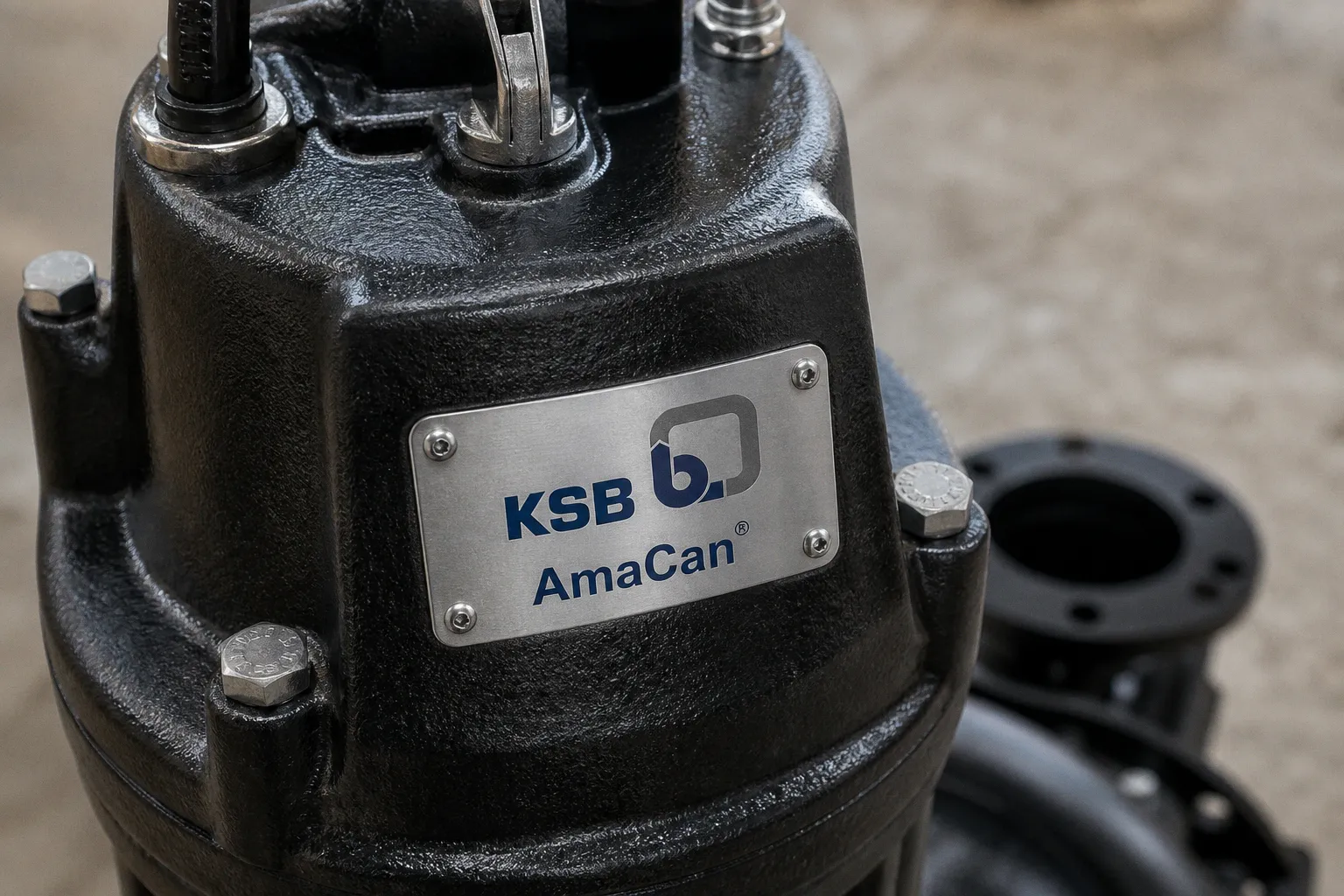
The next-generation portfolio is positioned around clog resistance, operating reliability, energy efficiency, and longer service life. For teams selecting equipment on the ground, the important question is not simply what is new, but which of those promises addresses the failure points you see during an ordinary shift.
The practical meaning of the AmaCan announcement
A submersible pump earns its place in a wastewater or drainage installation when it continues to move the intended fluid without turning every blockage, service call, or performance drop into an operational event. That is the daily reality behind terms such as clog resistance and reliability: fewer interruptions for operators, less time spent investigating a stalled installation, and more confidence that the equipment will behave consistently when access is difficult.
KSB has announced the AmaCan P and AmaCan D as separate series, but the available information does not provide the detailed technical distinction between them. We should therefore avoid treating the two names as interchangeable or assuming that one is automatically the better choice. The correct route is to match the selected version to the actual duty: municipal wastewater, industrial wastewater, or drainage, together with the site conditions and the maintenance approach available to the team.
If the installation regularly handles material that can interfere with pumping, then clog resistance deserves to be examined first. If energy use is a significant operating concern, then the efficiency claim needs to be connected to the pump’s expected duty rather than read as a universal saving. And if operator fatigue is already being driven by repeated interventions, the service-life and reliability claims matter only when they translate into fewer disruptive tasks in real-world context.
What to check before specifying
The announcement gives us the direction of the product family, not a complete selection sheet. Before moving from interest to procurement, we would want the supplier or engineering team to clarify:
- which AmaCan series is intended for the specific wastewater or drainage duty;
- how clog resistance is achieved and under what operating conditions it applies;
- what information is available to assess energy efficiency for the planned installation;
- how longer service life is defined and which components or operating conditions it concerns;
- what maintenance access, inspection routines, and service support are expected on site.
This is where the difference between a catalogue promise and a workable installation becomes visible. A pump may look well suited on paper, but if the operator cannot easily inspect it, if the duty point is poorly matched, or if the site team lacks a clear maintenance route, the hardware will still create friction during the shift. Good equipment selection is therefore an if-then exercise: if the main risk is blockage, prioritise the evidence behind clog resistance; if the main concern is continuous operating cost, ask for performance information relevant to the actual duty; if access is difficult, evaluate the service implications before the purchase is finalised.
Why this matters for wastewater teams
For municipal and industrial users, KSB’s announcement signals an expansion of its submersible pump portfolio rather than a single, one-size-fits-all replacement. That matters because wastewater and drainage installations rarely fail in abstract ways; they fail at the point where fluid conditions, site constraints, maintenance access, and operator workload meet.
The next useful step is to treat AmaCan as a series to investigate, not a conclusion to accept without qualification. Confirm the application fit, request the technical details that are not included in the announcement, and compare them with the conditions your team handles every day. When the design is right, the benefit is felt well beyond the pump itself: less time spent responding to avoidable interruptions, clearer decisions for the people maintaining the system, and a more manageable working day on the factory floor.