Edge NYC Tickets: Booking Mistakes That Cost Time and Money
The most expensive mistake in the Edge NYC booking process is not necessarily choosing the wrong admission tier. It is buying a non-refundable ticket without understanding what that decision removes.
Visitors often focus on the headline price, select a date, and move through checkout quickly. The cost becomes visible only when the itinerary changes: a flight is delayed, a meeting runs late, the weather looks worse than expected, or the chosen time slot no longer fits the day. At that point, the reservation is not a flexible travel asset. It is a fixed purchase with limited recovery options.
Edge NYC
- Official ticket — Advance bookingofficial ticketfromUSD34
Prices checked on August 18, 2026 · current price on the partner page.
Official website — edgenyc.com
- Time to spend: 2–3 h
Prices are indicative and may change — confirm the price and availability on the partner page.
Partner link — GetYourGuide ticketsThe booking architecture is straightforward but unforgiving. Cancellation Protection must be selected during the original purchase flow. A protected booking can qualify for a full refund when it is canceled at least two hours before the scheduled time slot. Without protection, the standard ticket is generally non-refundable, and adding flexibility after checkout is not an available workaround.
That distinction should be settled before choosing a time, not after the confirmation email arrives.
The Cancellation Protection Gap
Standard General Admission tickets at Edge NYC are non-refundable by default. Cancellation Protection is the add-on that can make a booking recoverable, but it has to be attached during the initial transaction. Once checkout is complete, visitors should not assume that the option can be added later or that an ordinary ticket can be converted into a flexible one.
Protected bookings are eligible for a full refund when canceled at least two hours before the scheduled entry time. The timing matters. A request made inside that window may not qualify, even if the visitor has a reasonable explanation. A missed entry and a timely cancellation are different events, and the policy treats them differently.
A non-refundable ticket without protection becomes a sunk cost when the itinerary changes, not when the visitor reaches the deck.
The two-hour cutoff is the practical boundary to build into the plan. Visitors may still contact the venue or booking provider with questions, but they should not treat a last-minute phone call or email as a guaranteed exception to the stated terms. Whether a request is accepted depends on the applicable policy and the timing of the cancellation; an informal appeal should never be the foundation of the booking strategy.
This is why the confirmation email deserves more attention than it usually receives. It contains the date, time, ticket type, and cancellation conditions that determine what can still be changed. A visitor who remembers only the purchase price may later discover that the crucial detail was the protection status.
Third-party bookings add another layer. When a ticket is purchased through a reseller, travel platform, or attraction-pass provider, that platform's terms may govern the refund request. Edge NYC's own protection terms should not be assumed to transfer automatically to every reseller transaction. Before paying, identify:
- Which company is issuing the ticket.
- Which company receives a cancellation request.
- Whether the booking includes protection at all.
- How far in advance a cancellation must be made.
- Whether the refund covers the full purchase or only part of it.
- Whether a time-slot reservation is separate from the admission credential.
The platform with which the visitor paid is often the first place to look when something goes wrong. A venue policy and a reseller policy may use similar language while applying different procedures. The important question is not simply whether a ticket is called flexible. It is which terms govern that specific confirmation.
Common failure modes include:
- Purchasing the cheapest tier without reviewing the protection option.
- Assuming that a standard ticket works like an airline fare with informal rebooking flexibility.
- Booking a time slot several days ahead and waiting until the morning of the visit to consider a change.
- Accepting a resold or gifted voucher without confirming its cancellation status.
- Skipping the policy screen during a fast mobile checkout.
- Confusing the venue's cancellation terms with those of a third-party platform.
- Assuming that a booking can be transferred to a different date because the visitor has not used it yet.
The protection option is easy to overlook because it appears as an add-on rather than as part of the base ticket. That design places the decision in the buyer's hands. The visitor receives a lower initial price, but also accepts more exposure if the itinerary is uncertain.
The right test is simple: if losing the ticket price would be painful, and the date or arrival time is not firm, the protection cost should be evaluated before the admission tier is finalized. It is not a substitute for reading the terms, but it can be the difference between a recoverable change and a total loss.
Maximizing Savings with Advance Saver Tickets vs. Peak Pricing
Advance Saver pricing is attractive because it exchanges flexibility for a lower admission cost. The discount can reach up to 35% compared with standard pricing when the ticket is purchased in advance for a specific date. The saving applies to a committed itinerary; it is not a general discount for anyone who happens to buy online.
That makes Advance Saver useful for visitors whose New York schedule is already stable. It is less useful for anyone still moving flights, meetings, restaurant reservations, or other timed attractions around the city. The lower price is not free flexibility. The fixed date is the trade-off.
| Pricing choice | What it changes | Where it fits |
|---|---|---|
| Advance Saver | Lowers the price for a set-date advance booking | A confirmed itinerary with little risk of change |
| Standard pricing | Preserves the ordinary booking structure without relying on the advance discount | Visitors who need a less restrictive purchase |
| Peak-time pricing | Adds a premium to high-demand periods | Visitors who value a particular time more than the lowest price |
| Flex Admission | Removes the fixed entry time on the selected date, at a higher base price | Uncertain arrival windows or weather-sensitive plans |
| Priority Access | Reduces queue exposure rather than changing the view | Tight schedules and short stays in Hudson Yards |
Visitors comparing Edge NYC tickets should distinguish three different amounts: the advertised base price, any time-based premium, and the final checkout total. A cheaper headline number is not automatically the cheaper transaction. Taxes, fees, ticket conditions, and add-ons can alter the comparison before payment.
This is especially relevant when several browser tabs are open at once. One page may display an attractive base price while another appears more expensive because its total already reflects a different ticket type or additional option. The useful comparison is the final amount for equivalent admission conditions—not the first number visible on the page.
The Sunset Premium Is a Timing Decision
Sunset is one of the most obvious sources of Edge NYC ticket price traps. High-demand periods can carry a premium, and the exact schedule may vary by season and operating conditions. Visitors should therefore check the price attached to the specific date and time they want rather than assume that every late-afternoon slot is priced the same way.
The important point is not to invent a universal boundary between ordinary and sunset pricing. There may be an attractive late-afternoon period on one date and a different pricing pattern on another. A slot that appears to be roughly an hour before sunset should not be treated as guaranteed to fall outside the surcharge window.
The decision is ultimately about the value of the timing. A sunset reservation may deliver a progression from daylight to the city's evening lights, but the premium buys a particular window rather than a fundamentally different deck. Earlier or later entry can still produce a strong skyline view, especially when the visitor is more interested in daylight, architectural detail, or a shorter wait than in the exact sunset moment.
Compare the options on the same date:
- The price of a standard time slot.
- The price of the desired sunset or near-sunset slot.
- Whether the selected slot includes the admission type actually needed.
- Whether Cancellation Protection is included or optional.
- Whether the visitor has enough time to arrive at Hudson Yards without turning the reservation into a race.
A lower-cost slot is not a saving if it forces the visitor to abandon another paid reservation or miss the entry window. Conversely, a premium sunset slot can be poor value when the schedule is uncertain and the ticket has restrictive cancellation terms. The best price is the one that survives contact with the itinerary.
When Advance Saver Stops Being a Saving
Advance Saver tickets lock the visitor into the selected date. That restriction is the mechanism behind the lower price: the venue receives a more predictable reservation, while the buyer accepts less room to adjust.
For a confirmed trip, the trade-off can be sensible. For a trip with unresolved logistics, it can be false economy. The apparent discount disappears if the visitor must purchase another ticket after a date change. Before selecting Advance Saver, ask whether the date is genuinely fixed or merely preferred.
A reliable booking sequence is:
1. Establish the day on which the visitor will actually be in the area.
2. Estimate the arrival window at Hudson Yards, including travel time and other reservations.
3. Decide whether the itinerary can support a fixed entry time.
4. Compare the Advance Saver price with the cost of retaining more flexibility.
5. Add Cancellation Protection if the booking terms and the visitor's risk justify it.
6. Review the final total, including any applicable taxes, fees, and time-based premium.
The common mistake is to begin with the most desirable time slot and work backward. That approach makes the visitor emotionally committed to a particular sunset or skyline moment before checking whether the ticket can be changed. Price, timing, and refund conditions should be considered as one transaction.
Navigating Entry Tiers: General, Flex, and Priority Access Explained
The admission tiers solve different problems. General Admission is primarily a price-and-precision choice. Flex Admission is a price-and-uncertainty choice. Priority Access is a time-and-queue choice. They should not be treated as interchangeable upgrades.
General Admission
General Admission ties the visitor to a specific time slot. It is usually the logical choice when the day's schedule is stable and the visitor can reach Level 4 of The Shops & Restaurants at 30 Hudson Yards with time to spare.
The risk is not merely being a few minutes late. A timed reservation is capacity assigned to a particular period. During busy periods, a late arrival may lose the practical advantage of that reservation and face a different wait or entry process. The exact consequence depends on the day's crowd conditions and the venue's operating procedures, but the central point remains: General Admission is a commitment, not a suggestion.
It works well for:
- Visitors with a predictable route through Manhattan.
- Travelers who have left a buffer before the reservation.
- People prioritizing the lowest reasonable admission cost.
- Itineraries that do not depend on a delayed flight, meeting, or meal.
It works poorly when the visitor has built several tightly timed activities around the same afternoon. The more moving parts in the day, the more expensive a missed slot can become.
Flex Admission
Flex Admission removes the fixed entry time on the selected date, in exchange for a higher base price. It is designed for visitors whose arrival window is uncertain but whose date is still known.
That distinction matters. Flex is not the same as unrestricted rescheduling to another day. It addresses timing within the selected date; it should not be read as a blanket promise that the reservation can be moved whenever plans change. The applicable terms should be checked before purchase.
Flex can be rational for:
- Visitors arriving from an airport or another borough with an uncertain travel time.
- Travelers coordinating several attractions around Hudson Yards.
- Families whose pace is difficult to predict.
- Visitors who want to adjust around changing visibility without abandoning the date.
- Anyone for whom the cost of a rigid missed slot is higher than the Flex premium.
Flex does not eliminate every queue. It reduces the risk created by a fixed arrival time, but demand can still be high during popular periods. A visitor who buys Flex expecting immediate entry at the busiest point of the day may still be disappointed.
Priority Access
Priority Access changes the queue experience rather than the view. It can be useful when the visitor has a short window in Hudson Yards: a cruise passenger on a limited stop, a business traveler between meetings, or anyone with a later reservation that cannot move.
The value depends on the visitor's schedule and on the expected crowd. Someone with an open afternoon may gain little from paying to reduce a wait that can simply be absorbed. Someone with a tightly managed itinerary may regard the same upgrade as inexpensive schedule insurance.
Priority Access should not be confused with Flex Admission. The former concerns queue priority; the latter concerns the timing model. Depending on the product selected, these features may be available in different combinations, so the checkout description should be read rather than inferred from the label.
| Visitor situation | More suitable starting point | Main risk to manage |
|---|---|---|
| Fixed itinerary and cost-sensitive visit | General Admission | Arriving outside the reserved window |
| Known date but uncertain arrival time | Flex Admission | Assuming Flex permits a different date |
| Very limited time in Hudson Yards | Priority Access, where available | Paying for queue reduction without needing it |
| Desired sunset experience | A time-specific booking reviewed for its premium | Paying extra for a slot the schedule cannot support |
| Weather-sensitive day | Flexible timing or protection, depending on the terms | Confusing poor visibility with an automatic closure |
The tier mismatch usually begins with a vague idea of the day. Visitors know that they want to visit Edge, but they have not decided whether the priority is price, schedule control, or speed. Once that priority is explicit, the choice becomes less complicated.
Leveraging Tourist Passes for Edge NYC Admission
General admission to Edge NYC is included in several major tourist passes, including the New York Pass, the New York Sightseeing Pass, and the Go City New York Explorer Pass. For a pass holder, the pass serves as the admission credential, but that does not make every visit cost-effective.
The correct calculation is not whether the pass includes Edge. It is whether the pass will be used enough to justify its total price. A visitor who plans to use the pass for several included attractions within its validity period may find that Edge fits efficiently into the overall itinerary. A visitor buying a pass only to avoid paying separately for Edge may spend more than necessary.
The pass decision should be made across the whole trip:
- List the attractions the visitor would actually visit, not every attraction theoretically available.
- Compare the combined individual prices with the pass price.
- Account for the visitor's pace and opening hours.
- Check whether reservations are required for the attractions in question.
- Treat premium time slots and upgrades as possible additional costs.
- Confirm how the pass validity period begins and how it is measured.
Several Edge NYC ticket booking mistakes appear at the pass stage.
A visitor may buy a pass solely for Edge access and then discover that the rest of the itinerary is too full to use it elsewhere. Another may assume that pass admission includes Priority Access. It does not automatically follow that a pass removes every queue or premium. A third may hold overlapping passes from different providers, creating duplicate coverage without an additional benefit.
Pass validity is another source of confusion. Many passes measure validity in calendar days from activation rather than in rolling 24-hour periods. The exact terms vary by provider, so the activation decision should be made with the itinerary visible. Activating a pass for a single late-day attraction can consume more of its useful validity than a visitor expects.
Admission and Time-Slot Reservations Are Not Always the Same Thing
A pass can cover admission while the reservation process still requires a time slot. Those are separate functions:
- The pass proves eligibility for entry.
- The reservation controls when the visitor is expected to arrive.
- A premium time slot may carry a separate charge.
- The reservation may have its own cancellation or no-show terms.
This distinction is particularly important during busy periods. A visitor who arrives with a pass but has not secured any required reservation may be admitted through the available process, yet still face a standby wait. The pass does not necessarily guarantee immediate boarding.
Sunset creates another common mismatch. Tourist passes generally cover the base admission included in their terms; they should not automatically be assumed to cover a premium attached to a high-demand time slot. If the reservation page shows a separate surcharge, the visitor should include it in the total cost of the pass-based visit.
The pass is useful when it reduces the total cost of a broader sightseeing plan. It is not a magic override for Edge's timing, queue, or premium-pricing rules.
A tourist pass can solve the admission-cost problem while leaving the timing problem completely intact.
Weather Contingencies and Arrival Protocols for the 100th Floor
Edge NYC is an observation deck, but ordinary rain or cloud cover does not automatically mean closure. The venue can operate in weather that makes the view less impressive, and visibility can vary independently of whether precipitation is falling.
That creates two separate decisions. The first is whether the venue is open. The second is whether the view is worth the visitor's time and ticket under the current conditions. A cloudy forecast may reduce visibility without canceling the reservation. A severe-weather or safety decision, on the other hand, may affect operations directly.
Visitors should not cancel a protected booking merely because the forecast is overcast and assume that the weather itself removes their refund rights. If the booking is canceled at least two hours before the scheduled slot, the stated Cancellation Protection terms may still allow a full refund. The entitlement depends on the timing and terms of the cancellation—not on whether the visitor personally expects a good view.
At the same time, protection should not be treated as a guarantee that every weather-related decision will be refunded. Poor visibility, rain, and an official closure are not necessarily handled in the same way. If the venue changes operations because of safety conditions, the instructions sent to affected visitors and the terms attached to that booking control what happens next.
The weather misread runs in both directions:
- Some visitors cancel too early because they equate cloud cover with closure.
- Others assume that an open deck guarantees a clear skyline.
- Some choose a rigid, low-cost time slot despite an itinerary that may need to move.
- Others pay for a premium sunset period without accepting that visibility may still be poor.
- Some wait until the final hours to make a decision, leaving no room inside the cancellation window.
The practical approach is to monitor the forecast without treating it as an operational notice. If the venue has not announced a change, the scheduled visit remains a scheduled visit. If the visitor wants the option to cancel, the two-hour cutoff must be preserved. Waiting for perfect certainty can mean waiting past the point at which a refund is available.
Finding the Actual Entry Point
The arrival protocol creates a separate opportunity to lose time. The main entrance to Edge NYC is on Level 4 of The Shops & Restaurants at 30 Hudson Yards, rather than at a street-level entrance that can be identified from a quick glance at the building exterior.
Visitors who navigate first to the building lobby may need to retrace their route through the mall concourse. That detour matters most when the reservation is tied to a specific time or when Priority Access was purchased to protect a narrow schedule. The route to the venue should be treated as part of the booking plan, not as a detail to solve after arriving at the address.
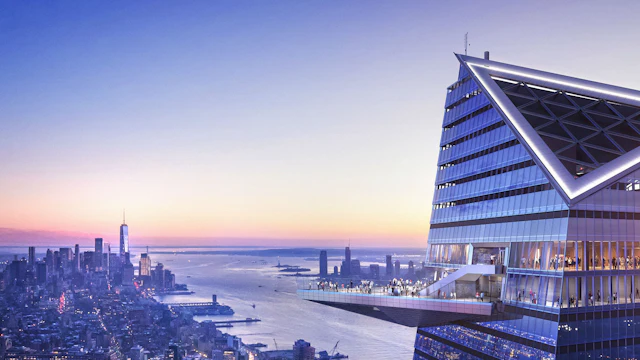
The observation deck sits 1,130 feet (345 meters) above ground level. The elevator ride itself is brief, but the approach to the elevator bank, security or admission checks, and the queue at Level 4 all consume time. The height is the memorable specification; the entry sequence is what determines whether the visitor reaches the deck calmly or arrives already negotiating the clock.
A useful arrival buffer accounts for:
- The walk from the visitor's previous destination.
- Navigation through Hudson Yards.
- The time needed to locate Level 4.
- Ticket or pass verification.
- The possibility of a queue during a popular slot.
- The distance between the venue exit and the next reservation.
Priority Access may reduce some queue exposure, but it does not remove the need to arrive at the correct place. Flex Admission may reduce the risk of missing a rigid time, but it does not make the venue immune to crowds. The products solve specific problems; neither replaces basic wayfinding.
Early entry periods are often attractive to visitors who want to minimize crowd pressure, while later periods may be chosen for changing light over the skyline. The right choice depends on whether the visitor is optimizing for queue conditions, photography, or the rest of the day's schedule. There is no need to claim that one period is always best. The booking should reflect the purpose of the visit.
Sequencing the Booking Decision
The most reliable way to avoid Edge NYC ticket booking mistakes is to make the decisions in the order in which they affect one another.
1. Confirm the date on which the visitor will be in Manhattan.
2. Estimate the realistic arrival window at Hudson Yards.
3. Decide whether a fixed General Admission time is workable.
4. Consider Flex if the date is firm but the arrival time is not.
5. Check whether a tourist pass already covers the base admission.
6. Compare Advance Saver pricing with the cost of retaining flexibility.
7. Check the price of the chosen time slot, including any peak or sunset premium.
8. Decide whether Priority Access has a real schedule value.
9. Review Cancellation Protection and the two-hour cancellation condition.
10. Compare the final checkout totals, not just the advertised ticket prices.
11. Save the confirmation and note the entry location on Level 4.
This order prevents the most expensive reversal. A visitor who selects a premium sunset time first, then discovers that the date is uncertain, may end up choosing between losing the booking and paying again. A visitor who checks the itinerary first can decide whether the premium is worth accepting before the reservation becomes restrictive.
The sequence also clarifies the role of the tourist pass. Pass coverage should be checked before paying for separate admission, but it should not end the analysis. The visitor still needs to examine time-slot availability, premium charges, reservation requirements, and cancellation terms.
Budget-conscious visitors should not automatically choose the lowest base price. The cheapest ticket is often the one with the narrowest margin for error. If a missed reservation would force a replacement purchase, the initial discount may be less meaningful than it appears. The relevant figure is the expected total cost of the day, including the possibility of a change.
Schedule-conscious visitors should make the opposite calculation. Priority Access may be unnecessary for an open afternoon, but it can be reasonable when a cruise departure, business meeting, or timed attraction makes queue uncertainty expensive. The upgrade is valuable only when the saved time has somewhere useful to go.
The same logic applies to Flex. Buying it for every visit wastes money; refusing it when the arrival window is genuinely unstable creates avoidable risk. The tier should follow the itinerary, not the label's marketing appeal.
Closing
Edge NYC's ticket architecture rewards visitors who separate price, timing, queue access, and refund protection before checkout. Advance Saver can reduce the cost of a confirmed plan, but its value depends on accepting a fixed date. General Admission can be the efficient choice for a precise itinerary, while Flex protects a known date from an uncertain arrival time. Priority Access is a queue decision, not a better-view decision. Tourist passes can lower the broader cost of sightseeing, but they do not automatically erase reservation rules or premium time-slot charges.
Weather requires the same discipline. Cloud cover is not the same as closure, and a protected booking canceled at least two hours before its slot may remain eligible for a full refund even when the reason is concern about overcast conditions. The operational status of the venue and the visitor's personal assessment of the view are separate questions.
The expensive mistakes are therefore predictable: buying without protection, treating Advance Saver as flexible, choosing a sunset slot without checking its actual price, confusing a pass with a guaranteed boarding time, and arriving at the wrong level with no buffer. None of these problems is difficult to prevent. They become expensive only when the visitor postpones the decision until after payment.
The deck is fixed at 1,130 feet above the city. The booking path is where the variable cost lives.