Museum of Senses Tickets: Online Booking vs. On-Site
A visit to the Museum of Senses in Bucharest can be wonderfully simple or slightly awkward before you even reach the first optical illusion.
The difference usually comes down to how you buy your ticket: reserve online and arrive with a mobile voucher, or walk into AFI Cotroceni and join the ticket-office queue.
 Bucharest
Tickets and prices
Museum of Senses
Entry ticket · 1 hour
fromRON68.34
Check availabilityOfficial ticket · Ages 16+ (Monday–Thursday)
fromRON65
Check availabilityThat choice matters because the museum is designed around a fairly compact visit. Most people need around 90 minutes to move through its sensory zones, with the full experience typically taking between one and two hours. Losing part of that window while waiting at the counter can change the rhythm of the visit, particularly if you are fitting the museum between lunch, shopping, a cinema booking, or another Bucharest attraction.
We can treat the decision much like any piece of equipment on a busy factory floor: the best option is not always the one with the lowest apparent effort at the beginning. It is the option that gives you the clearest operating condition once you are on the ground.
Museum of Senses Bucharest: location, access, and the first practical decision
The Museum of Senses is inside AFI Cotroceni Mall, on the first floor in the IMAX area, at Bulevardul General Paul Teodorescu 4. This is useful to know before you set out because the museum is not a separate street-front building with an obvious entrance of its own. Your arrival begins in the mall, and you then need to navigate to the correct level and area.
That sounds minor, but it is exactly the kind of detail that creates operator fatigue in real-world context: you arrive with children, a group, or a fixed time slot, and the first few minutes are spent working out where the attraction actually starts. If you are using public transport, Politehnica metro station is one of the nearby reference points commonly associated with reaching AFI Cotroceni, but the final part of the journey still involves entering and crossing the shopping centre.
The museum is generally open daily from 10:00 AM to 10:00 PM, with last entry permitted at 9:15 PM. The late closing time gives you flexibility, although we would not recommend treating the final entry window as a comfortable start time. A 9:15 PM admission leaves little room for a relaxed visit if you want to explore all 11 rooms rather than make a quick circuit.
There are more than 40 interactive exhibits, including familiar highlights such as:
- the Ames Room, where perspective changes the apparent size of the people inside it;
- the Vortex Tunnel, which challenges your balance and visual orientation;
- the Mirror Maze, where reflections make a straightforward path much less straightforward;
- the Bed of Nails, a tactile exhibit that is usually approached with a mixture of curiosity and caution;
- infinity-mirror and upside-down-room installations that work particularly well for photographs, provided visitors are willing to pause and follow the instructions.
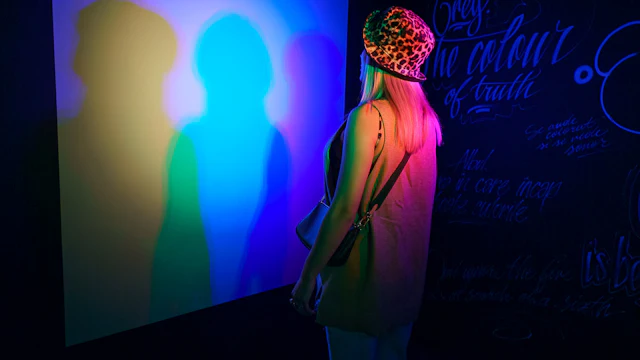
The attraction is not a conventional museum in which you move quietly from one object label to the next. It is closer to a sequence of controlled encounters: light, balance, reflection, proportion, touch, and spatial perception are all part of the operating environment. That is why the entry process deserves a little planning. Once inside, the experience is more enjoyable when you are not watching the clock or wondering whether your group will be admitted.
The ticket decision is really a queue decision: online booking removes one point of friction before the sensory experience begins.
Online booking: the smoother route when your timing matters
Booking Museum of Senses tickets online gives you an electronic mobile voucher and allows you to avoid the on-site ticket-office queue. In practical terms, you arrive at the mall, find the museum, and present the voucher from your phone rather than beginning with a separate purchase step at the counter.
That distinction is especially useful during a day with several moving parts. If you have planned to spend an hour or two in AFI Cotroceni before continuing elsewhere, the online route provides a more predictable starting point. We are not claiming that online tickets are always cheaper; the exact price can vary by provider, currency, and booking conditions, and the physical box-office price is not consistently published in a way that supports a reliable comparison. The clear advantage is operational rather than automatically financial: a reserved entry and less time spent in the purchase queue.
The online process generally suits you if:
- you are visiting at a specific time rather than simply passing through the mall;
- you are travelling with children who do not enjoy standing still in a queue;
- your group has a limited schedule for the day;
- you want your entry details available before arriving;
- you are visiting during a busy period and would rather reduce uncertainty at the door;
- you have already decided that the Museum of Senses is part of the day’s plan.
The mobile voucher also removes a small but familiar source of tactile friction: searching for cash, opening a banking app at the counter, checking several phones for confirmation, and keeping a group together while the transaction is completed. None of those steps is difficult in isolation. Together, they can make the start of a visit feel less controlled than it needs to be.
What online booking does not guarantee
An online voucher does not turn the whole visit into a private tour, and standard admission should not be assumed to include a guided tour. It simply addresses the entry transaction and, where the booking terms provide it, the wait at the ticket office.
You should still check the voucher instructions before leaving your hotel or apartment. Look for:
- the date and admission conditions shown on the booking;
- whether the voucher is accepted directly from a mobile phone;
- any instructions about where to present it;
- cancellation or amendment terms;
- whether a particular time or entry window applies.
The practical rule is straightforward: if-then planning works better than optimism. If you have a mobile voucher, your phone is charged, and the booking instructions are accessible, then the arrival process should be relatively direct. If the voucher is buried in an email account you cannot access, the screen brightness is too low, or your group has not agreed on the meeting point, the online advantage becomes much smaller on the ground.
We also recommend saving the voucher before you enter the mall. A screenshot may be useful as a backup, although you should follow the booking provider’s stated requirements rather than assuming every voucher can be handled in exactly the same way.
Buying Museum of Senses tickets at the entrance
On-site purchase remains the more flexible choice for visitors who are already in AFI Cotroceni and have not committed to a particular schedule. You can decide after shopping, eating, or visiting another attraction in the mall, then go to the museum and ask about admission at the ticket office.
This approach is appealing because it keeps the day open. If you are travelling without a strict itinerary, the ability to change your mind has real value. A museum visit is not always something you want to lock into the morning when the weather, energy levels, or children’s patience may change by lunchtime.
The trade-off is the queue. On-site tickets require you to wait at the ticket office if other visitors are purchasing at the same time. The length of that wait is not fixed, and it is not sensible to promise that a particular weekday or hour will always be quiet. Mall traffic, school holidays, weekends, group arrivals, and seasonal visitor patterns can all change the conditions.
This is where we need to distinguish flexibility from predictability:
| Consideration | Online booking | On-site purchase |
|---|---|---|
| Entry preparation | Voucher ready before arrival | Purchase begins at the museum |
| Ticket-office queue | Designed to help you avoid it | You may need to wait |
| Schedule | Better for a planned itinerary | Better for a spontaneous visit |
| Price certainty | Depends on provider and currency | Exact current counter price should be confirmed on arrival |
| Group coordination | Easier to organise in advance | More decisions happen at the entrance |
| Main advantage | Reduced arrival friction | Maximum flexibility |
| Main drawback | Less spontaneous if plans change | Waiting time is unpredictable |
On the ground, buying at the counter makes most sense when the queue itself is acceptable to you. If you have nowhere else to be and your group is comfortable waiting, the absence of an online reservation may not create a problem. If you have booked a meal, planned a museum-hopping route, or are travelling with a tired child, the same queue can become the dominant part of the experience.
There is also a psychological difference. With online booking, the purchase decision is completed before the visit begins. At the counter, you are making the decision while standing in the entrance environment, possibly with several people behind you and a group asking what happens next. That is not a serious obstacle, but it is a different kind of interaction, and some visitors find it more tiring than expected.
Which option is better for families, groups, and spontaneous visitors?
There is no universal winner between Museum of Senses Bucharest online booking and on-site tickets. The right choice depends on how much uncertainty your day can absorb.
If you are travelling with children
Online booking is usually the calmer arrangement. Children may enjoy the exhibits, but they are rarely enthusiastic about the administrative stage that comes before them. A queue can be manageable when everyone is rested and interested; it can feel much longer after a full morning of walking through Bucharest or a busy mall.
The online route also lets you explain the plan in advance: we arrive at AFI Cotroceni, go to the first floor near the IMAX area, show the voucher, and begin. That simple sequence reduces the number of decisions made while your group is already moving.
Once inside, remember that some exhibits change balance and visual orientation. The Vortex Tunnel, Mirror Maze, and perspective rooms may be exciting, but they can also be disorienting. Allow a little space between members of your group, especially when children are moving quickly from one installation to another. Good tactile feedback is not only a product-design concern; here, the handrails, floor transitions, and instructions are part of how visitors understand the environment.
If you are travelling as a couple or small adult group
Either option can work. Online booking is preferable when you have built the museum into a timed itinerary. On-site purchase is reasonable when AFI Cotroceni is already part of your day and the Museum of Senses is a flexible add-on.
A small group also has an advantage at the exhibits: you can take turns photographing one another in the Ames Room, upside-down room, or infinity-mirror installation without needing to coordinate a large party. That makes the visit feel less like a procession and more like a sequence of short experiments.
If you are visiting Bucharest without a fixed plan
On-site tickets preserve the most freedom. You can decide based on weather, energy, and how much time you have left in the day. The key is to accept that you may encounter a ticket-office queue and that current counter pricing should be confirmed directly at the entrance.
If the queue is short, you gain flexibility without much cost in time. If it is long, you can decide whether waiting still fits your day. That is the advantage of an uncommitted plan: you have not already built the rest of your schedule around a specific entry assumption.
If you are visiting during a busy travel period
Online booking is the safer operational choice. It does not remove every possible delay, but it addresses the most visible one: purchasing admission at the ticket office. You also have a clearer record of your booking and a defined plan before arriving.
The museum may also have holiday-related blackout dates or altered availability around 24 and 25 December, 31 December, 1 January, and Easter Day. These dates should be checked against the booking conditions for your intended visit rather than treated as a complete annual calendar, because holiday arrangements can change.
Making the most of a 90-minute visit
The Museum of Senses is compact enough for a focused visit, but the exhibits do not all operate at the same pace. Some can be understood in seconds; others invite you to try a different position, repeat an illusion, or take a photograph. If you hurry through every room, you may technically see the whole museum while missing the reason people remember it.
A useful approach is to think in three phases.
First, allow time to orient yourself. The museum contains 11 sensory rooms and more than 40 interactive exhibits, so the first few installations establish how the experience works. Read the instructions, notice where visitors are expected to stand, and do not assume that the most obvious position produces the strongest effect.
Second, move through the high-interaction exhibits without creating pressure for the next person. The Mirror Maze and Vortex Tunnel are easier to enjoy when you are not trying to solve them at speed. In a working environment, we talk about operator fatigue when a person has to make too many small corrections without a clear visual or physical reference. The same principle applies here: pause, regain orientation, then continue.
Third, leave room for the exhibits that depend on photography. Perspective rooms and mirror installations often require one person to stand in a particular place while another takes the picture. If your group wants photographs, your actual visit may take closer to two hours than a quick 90-minute circuit.
Here is a practical pacing model:
1. Arrival and entry: Keep your voucher or payment method ready before reaching the entrance, so the first minutes are not spent searching through bags and phones.
2. Orientation: Read the instructions for each room instead of treating them as decoration; they usually explain how to produce the intended effect.
3. Main circuit: Move steadily through the installations, but pause when an exhibit changes your sense of balance, distance, or scale.
4. Photography: Take turns rather than allowing one person to become the permanent photographer for the entire visit.
5. Final room and exit: Give yourself enough time to finish without rushing toward the last entry cutoff or the mall’s closing routine.
You do not need specialist knowledge to enjoy the museum, but you do need a little cooperation from your group. The best sensory experiences depend on people standing in the right place, allowing others to try, and respecting the physical boundaries of each installation.
A well-planned visit leaves enough time for curiosity; a badly timed one turns every exhibit into another item to clear before the next appointment.
Museum of Senses entry fee, booking conditions, and changing details
Visitors often search for the Museum of Senses Bucharest entry fee as if there were one permanent number that settles the decision. In practice, online prices can vary between booking providers and may be displayed in different currencies, while the exact current price at the physical counter is not something we should present as fixed.
For that reason, treat price as a live booking detail rather than a permanent feature of this guide. Check the amount, currency, and conditions at the point of purchase. Do not assume online booking is automatically cheaper than buying at the museum, because a third-party provider may apply its own pricing or booking terms.
The more stable comparison is the one that affects your day:
- online booking generally gives you a mobile electronic voucher and helps you avoid the ticket-office queue;
- on-site purchase gives you the freedom to decide after arriving at AFI Cotroceni;
- neither option should be treated as a guarantee of a guided tour unless the specific ticket description says so;
- operating hours are generally 10:00 AM to 10:00 PM, with last entry at 9:15 PM;
- holiday availability may differ, so dates around Christmas, New Year, and Easter deserve a separate check.
This is also why we would not plan to arrive at 9:10 PM simply because last entry is listed as 9:15 PM. A final-entry limit is an operational boundary, not a promise of a relaxed experience. You still need to reach the museum inside the mall, complete any required admission step, and allow enough time to move through the rooms.
Our practical recommendation
Choose online Museum of Senses tickets when your visit is planned, your time is limited, or you are travelling with a group that will find a queue tiring. The booking process gives you a mobile voucher and reduces one of the least interesting parts of the experience: waiting to purchase admission after you have already made the journey.
Choose on-site tickets when you are already at AFI Cotroceni, your schedule is open, and the museum is one possible activity rather than a fixed appointment. You gain spontaneity, but you accept that the ticket-office queue may be longer than expected and that the current counter price must be confirmed at the time.
For most visitors who already know they want to go, online booking is the more controlled route. It does not make the museum more exciting, and it does not replace the need to check your voucher, but it gives you a cleaner handoff from travel to entry. Once you are inside, your attention can move where it belongs: to the change in scale in the Ames Room, the unstable feeling of the Vortex Tunnel, the repeated reflections of the Mirror Maze, and the strangely persuasive physical logic of the Bed of Nails.
That is the real value of good planning in a place like this. It is not about squeezing every second from the day. It is about removing the small sources of friction that make people tired before the interesting part has even started, so you can arrive with enough patience, energy, and curiosity to experience the museum as it was designed to be experienced.
Practical info
Currency: RON
Driving: on the right
Emergency number: 112