Wave Island Tickets: A Step-by-Step Booking Route
The 1.00-meter height threshold at Wave Island is the primary sorting variable. Adult rate, child rate, or free entry: the discriminator is height, not age, and the tolerance is narrow.

Children measured at 0.99m enter free; at 1.01m, they fall into the child tier. Every downstream booking decision propagates from this measurement.
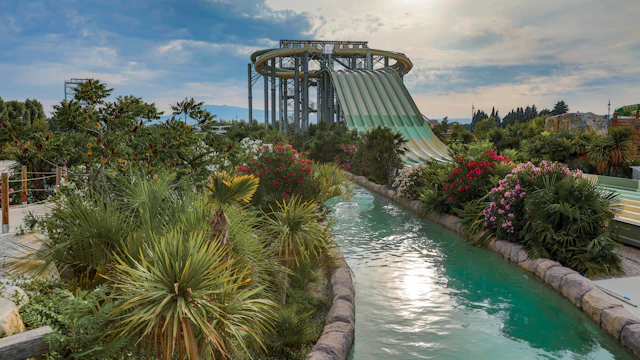
Wave Island
- Official ticket · Under 11official ticketfrom€26
Prices checked on August 16, 2026 · current price on the partner page.
Official website — waveisland.fr
Prices are indicative and may change — confirm the price and availability on the partner page.
Partner link — GetYourGuide ticketsThe 2026 operating season runs June 13 through August 30, with daily operations from 10:00 to 18:00. A final weekend opens September 5–6. Visitor throughput at the entrance gate scales with this window. Pre-purchased mobile tickets reduce gate latency by eliminating the cashier queue. This is the optimal configuration for throughput. Visitors who arrive without tickets incur higher gate latency.
The booking system rewards preparation. Families who measure children before arrival, select the correct tier, and arrive with a scanned barcode on a charged phone enter the park in seconds. Families who defer these decisions to the gate encounter friction at every checkpoint. The difference is not marginal—it compounds across height verification, ticket validation, and payment processing.
Pricing Tiers and Eligibility
The ticket matrix is defined by three measured inputs: age, height, and category. The standard adult rate applies to anyone aged 11 or older. The standard child rate applies to anyone between 1.00m and under 11 years old. Children under 1.00m enter free.
The free entry is not a transactional process. It is a physical verification at the gate. No online e-ticket code is issued for this category. The system design eliminates one specific error class: the pre-purchased free ticket that fails at the turnstile. Visitors attempting to book a free ticket online will leave the channel without a valid code. This is correct behavior, not a bug.
The 1.00-meter threshold is the system's primary gate. Everything else is downstream.
Reduced tiers exist for specific categories:
| Category | Rate | Documentation Required |
|---|---|---|
| Pregnant women | €25 | Official proof at gate |
| Seniors over 65 | Reduced | ID at gate |
| Visitors over 120 kg | Reduced | Official proof at gate |
| Disabled visitors | Reduced | Official proof at gate |
These categories are not universally accessible through all online booking channels. The standard e-ticket flow does not always surface these variants. Visitors in these categories should verify the booking path before payment. Expected additional gate processing time: typically 30 to 90 seconds per visitor for documentation verification.
The standard adult price for the 2026 season is €33. The standard child price is €26. These are the gate rates. The online and partner rates diverge from this baseline, and the differential is the leverage point for any booking strategy that goes beyond the default channel.
Children between 3 and 10 years old traveling with a paying adult sometimes qualify for the same child tier pricing through the online channel, which is worth confirming during the booking flow because the dropdown logic on the portal has been known to default to the most restrictive tier. Visitors who find the price displayed higher than expected should refresh the search and verify the selected age bracket before payment.
Online Booking and Mobile E-Tickets
The online channel is the lowest-latency path to entry. E-tickets are issued as mobile barcodes. Visitors scan the phone screen at the entrance gate. No paper exchange. No kiosk pickup. No printable document required.
The throughput gain is measurable. Visitors with pre-purchased tickets bypass the cashier queue. Standard gate latency at peak hours (12:00 to 14:00) without pre-purchased tickets frequently exceeds 15 minutes. With pre-purchased mobile tickets, the bar scan typically completes in seconds. The throughput differential is substantial.
Known failure modes in the mobile scan process:
- Phone battery below 20% increases scan error rate. The screen dims during the scan window. Visitors with low battery should screenshot the barcode and have the screenshot ready.
- Screen brightness at minimum setting fails outdoor barcode reading. Maximum brightness is required.
- Cracked screens cause intermittent scan failures. Visitors with damaged screens should print the barcode as a backup.
- Carrier signal is not required. The barcode is locally rendered. Airplane mode is acceptable.
The transaction system has known blind spots. Visitors requiring reduced-rate tickets may need to purchase a standard ticket online and request a rate adjustment at the gate, or book through a specialized channel. The cognitive load of identifying the correct channel is non-trivial. Visitor research is the only mitigation.
One additional variable worth noting: group bookings. Families or groups of six or more can sometimes access a bundled rate through the official booking portal, but the interface does not always make this option visible on the first screen. Scrolling past the standard single-ticket selector reveals group variants. The savings per ticket are modest—typically €2 to €4 per person—but they compound across a large party. The trade-off is rigidity: group tickets often require all members to enter together at the same gate scan.
The confirmation email arrives within minutes of payment. The barcode lives inside that email, not as an attachment but as an embedded image that some mail clients strip or block. Visitors using aggressive spam filters should check the spam folder, or open the email through the web client rather than a third-party app. iOS Mail, Gmail, and Outlook handle the barcode reliably; some third-party mail apps render the image as a broken link.
Preferential Rates Through Partner Tourist Offices
Tourist offices function as discount endpoints. Avignon Tourisme, for example, issues a single-rate ticket for all visitors over 1.00m. The rate is below the standard gate admission. The trade-off is constraint: the ticket is locked to the partner's terms, pickup logistics, or office hours.
The savings are measurable: the preferential rate for adult tickets is €26, compared to the standard gate rate of €33. The differential is €7 per ticket. For a family of four, the savings are €28. The cognitive load is higher at the partner channel. Visitors must verify:
- Office hours and location
- Pickup deadline (some tickets expire if not collected)
- Payment method accepted
- ID requirements, if any
The optimal use case: visitors already planning a stop at the Avignon tourist office, or those booking well in advance with no same-day time pressure. The suboptimal use case: visitors arriving the same day with no office stop planned. The travel time to the office may exceed the savings.
The partner channel does not always integrate with mobile e-tickets. Some partner tickets require physical pickup at the office. The transaction flow is therefore: partner purchase, office collection, park entry. One step longer than direct online booking.
Other regional tourist offices in the Vaucluse department also participate in the partnership program. Orange, Carpentras, and Cavaillon offices occasionally stock Wave Island tickets at preferential rates, though availability fluctuates across the season. Calling ahead to confirm stock is a low-cost step that prevents a wasted trip. The offices themselves operate on standard French administrative hours—typically closed Sundays and Monday mornings—which constrains the pickup window for weekend visitors.
Hotel concierges in the Monteux and Avignon area sometimes hold a small allocation of partner tickets as a guest service. The rate matches the tourist-office preferential rate, but availability depends entirely on the property and the season. Asking at check-in is a five-second step that can save the trip to the tourist office entirely.
Combined Passes: Parc Spirou and Wave Island
A combined ticket covers both parks at a fixed rate. The pass is available for anyone over 1.00m. This is a single transaction covering two parks, eliminating the second purchase decision.
The combined rate is €53 per visitor over 1.00m. The combined pass assumes the visitor will visit both parks. Visitors who buy the combined pass and skip Parc Spirou lose the rate differential. The pass is not a discount for Wave Island alone.
The error rate spikes when visitors misread the height threshold on the combined pass. Under 1.00m entry is free at Wave Island only. The combined pass does not apply below this threshold. The pricing logic assumes the visitor is tall enough to require a ticket at both parks.
The throughput trade-off: combined passes require verification at both park gates. Processing time per park is identical to the standard ticket flow. The total gate time is therefore higher for a combined visit than a single-park visit. This is expected, not a failure. The Parc Spirou gate is a separate scan.
Logistical sequencing matters for combined-pass holders. Parc Spirou and Wave Island share a geographic cluster near Monteux, but they are separate facilities with separate entrances, separate parking areas, and separate crowd dynamics. Mornings at Wave Island draw the water-park crowd; afternoons at Parc Spirou see theme-park traffic peak. Visitors who reverse this sequence—Parc Spirou in the morning, Wave Island after lunch—often encounter shorter queues at both gates. The combined pass does not enforce a sequence, so the visitor controls the routing.
A combined pass is a commitment to two parks. The math works only if both gates get scanned.
The pass is structured as a single purchase covering a single date. Cross-day visits (Wave Island one day, Parc Spirou the next) require two separate tickets, not the combined pass. The combined pass is engineered for the same-day double-park itinerary, not the spread-across-the-week version.
On-Site Logistics: Height Rules and Locker Variables
Two hard constraints govern the on-site experience: armbands and lockers.
Armbands. Children under 1.20m require armbands inside the park. This is a non-negotiable safety constraint, enforced at the gate. There is no waiver. Armbands are issued on-site at no additional cost. Processing time is typically a few minutes per child. The armband applies to all water attractions. Visitors without armbands are restricted from rides requiring flotation assistance.
The 1.20m threshold is distinct from the 1.00m ticket threshold. A child can be tall enough to require a paid ticket (over 1.00m) yet still short enough to need armbands (under 1.20m). This 20-centimeter band is where most booking confusion occurs. Parents who correctly purchase a child ticket sometimes assume the armband requirement does not apply. It does. The two thresholds serve different functions: one is billing, the other is safety.
Lockers. Lockers require a padlock. Visitors can bring their own or purchase a theme-branded padlock with key bracelet on-site for €9. The padlock is single-use for the visit duration. The key bracelet attaches to the wrist. The locker system has a measurable failure mode: visitors who arrive without a padlock and decline to purchase one cannot use the lockers. This is the expected behavior. The cost of the on-site padlock is the cost of the on-site padlock. There is no alternative channel.
The padlock decision should be made before walking through the gate. Visitors who realize mid-visit that they need a locker must retrace their steps past the gate scan to reach the retail outlet. That round trip costs twenty to thirty minutes depending on crowd density. Bringing a padlock from home—or buying one at the outlet before crossing into the park—is the friction-free path.
Additional on-site logistics:
- Food and beverage. Outside food and drink are generally restricted. Visitors with dietary requirements or infant formula should verify the current policy before arrival. The park operates food outlets on-site, but peak-hour queues at these outlets can extend to 20 minutes or more.
- Re-entry. Re-entry on the same day is permitted. Re-entry requires the original ticket or wristband. Visitors who leave the park without their wristband forfeit re-entry. This is a hard constraint.
- Photography. Personal photography is permitted. Commercial photography requires prior authorization. GoPro-style action cameras on rides are subject to individual attraction rules—some rides prohibit loose equipment for safety reasons.
- Pets. Pets are not permitted inside the park. Service animals are an exception, though documentation may be requested at the gate.
- Sunscreen and hydration. The park is predominantly outdoor with limited shaded areas. SPF 50+ sunscreen and water bottles are practical necessities, not optional extras. The on-site water fountains are spaced irregularly; carrying a bottle reduces dependency on fixed hydration points.
The system is designed for the measured visitor. Unmeasured variables produce failure at the gate.
Closing: Booking Heuristics
The fastest route to validated entry requires the following sequential steps:
1. Measure the shortest family member first. This determines the ticket category for all members. The measurement should be done with shoes off, against a wall, with a flat object on top of the head.
2. If under 1.00m: skip the online channel entirely. Free tickets are issued only at the gate after physical height verification.
3. If between 1.00m and under 11 years: buy the online child ticket. Scan at the gate from mobile.
4. If 11 or older: buy the online adult ticket. Same scan flow.
5. If visiting Parc Spirou: buy the combined pass. Verify both parks' operating hours match.
6. If booking through a tourist office: verify pickup terms before payment. Office hours, expiration, and ID requirements vary.
Additional booking heuristics:
- Phone screen brightness at maximum for the gate scan.
- Phone battery above 50% before arrival.
- Screenshot the barcode as a backup. Scan failures are recoverable with a screenshot.
- Armbands for any child under 1.20m, no exceptions. The constraint is hard.
- Padlock decision made before entering the park, not after. The on-site padlock is €9.
- Documentation for any reduced-rate category ready at the gate. Processing time without documentation is undefined.
- Arrive before 12:00 to avoid peak gate latency. The afternoon window is the highest-contention period.
- Check the weather forecast the morning of the visit. Wave Island operates rain or shine, but thunderstorm protocols can close outdoor attractions temporarily. A cloudy morning does not mean a wasted trip, but a lightning warning does mean a pause in operations.
The booking system is deterministic. The gate is deterministic. The variables are measurable. The failure modes are documented. Visitors who measure once, decide once, and follow the booking path will complete the transaction in seconds at the gate.