Ball valve seat materials: performance paths for industrial flow
A shift starts at six. By the time you've been on the floor for two hours, you've probably turned the same quarter-turn valve four times already, and each cycle is a small negotiation between your hand on the handle and the seat inside the body.
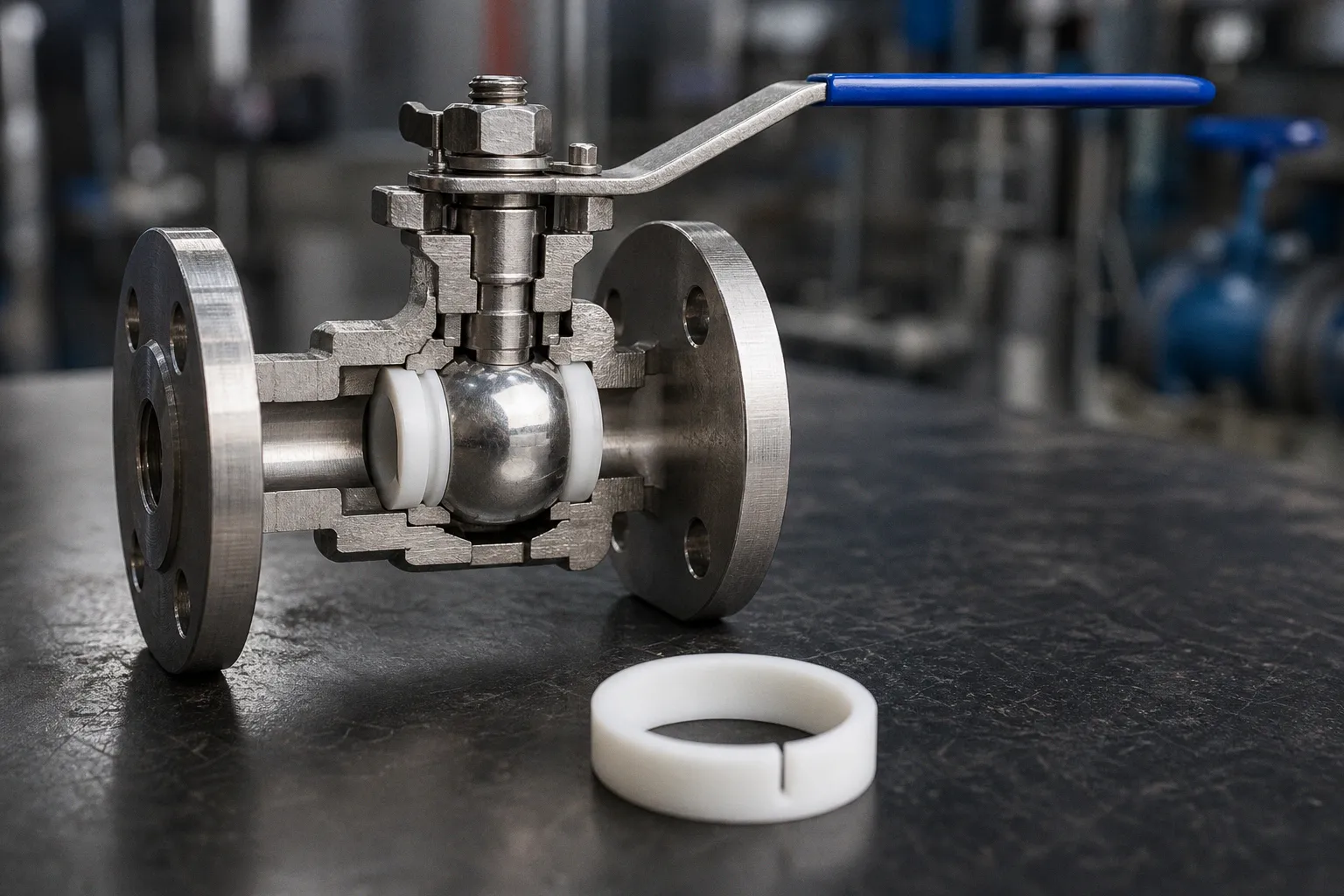
When the seat is doing its job, you never think about it: the handle meets a familiar resistance, the ball seats, and the line holds. When the seat isn't doing its job, the valve starts to short-cycle. The handle turns, the ball rotates, but the shutoff fades microgram by microgram, and the line that should be isolated begins to weep onto the deck. If you've ever crawled back to a tag-out point and found a soft, almost oily-looking ring of fugitive product around the gland, you've met the limits of a seat material choice that wasn't matched to the service. We talk about seats the way some people talk about tires: nobody asks which rubber is on the wheel until the wheel stops gripping.
Compare car rental deals in United Kingdom
See available offersPartner link — DiscoverCars comparisonIn industrial flow control, the seat is the unglamorous part of the bill of materials, and yet the way a process line feels in the hand, the way a turn of the handle either gives the operator a clear, confident "off" or a soft, uncertain "maybe", is set inside the seat, not the body. Walk a plant with us the way we've walked plants with new operators and you'll start to notice that the seats quietly decide whether the day feels predictable or whether you're walking back to the same valve with a wrench before lunch.
The mechanics of PTFE and reinforced polymers in flow control
Polytetrafluoroethylene is the default soft seat for a reason that's worth understanding from the inside out. PTFE has an unusually low coefficient of friction, is chemically inert to a remarkably wide range of media, and conforms to small surface irregularities on the ball when the valve is closed. That conformity is what gives you that crisp, tactile feedback when a soft-seated ball valve seats properly: the load builds smoothly, leaks fall away in a clean curve, and the handle settles into a defined stop. It feels right because the polymer is doing what polymers do, deforming just enough to bridge micro-gaps and then pushing back to keep the seal.
The challenge is that virgin PTFE is also soft in ways that the operator eventually feels. On a standard Jamesbury-class ball valve, the seat availability table that the manufacturer publishes will list PTFE alongside a family of reinforced and filled variants: reinforced PTFE, metal-wrapped filled PTFE, Delrin, PEEK, UHMW polyethylene, FEP, graphite-filled polyimide, and PFA. Each of those options trades a little of PTFE's softness for something else, and the trade is rarely visible until the service pushes it. Filled PTFE with carbon or glass gives you better wear resistance and a stiffer response to cycling; metal-wrapped filled PTFE pushes the temperature ceiling higher because the polymer is doing the conforming but a metal shell is sharing the load with the ball. PFA brings some of the chemical inertness of PTFE up into a higher temperature range. PEEK brings a fundamentally different mechanical profile altogether.
The seat availability table is the specifier's first map. It is not a ranking. It is a list of paths, and the path you take depends on where the service is going.
| Seat material family | Typical strengths | Typical limits | Where you'll see it |
|---|---|---|---|
| PTFE (virgin) | Lowest friction, broadest chemical inertness, soft conformability | Cold flow under sustained load or cycling; standard temperature ceiling | General chemical, low-pressure, low-cycle duty |
| Reinforced / filled PTFE (carbon, glass, stainless) | Stiffer matrix, better wear, holds tolerance longer | Marginal loss of low-friction feel; still polymer-based | Cycling service, higher differential pressure |
| Metal-wrapped filled PTFE | Polymer conformability with mechanical load sharing | More complex seat geometry; not a universal upgrade | Cycles that combine pressure with temperature |
| PEEK | High mechanical strength at temperature; holds tolerances | Vendor-specific restrictions; not for fire service in some lines | Higher-temperature chemical and steam service |
| UHMWPE, Delrin, FEP, PFA | Specialty chemical or temperature niches | Not drop-in replacements for PTFE | Specific media where PTFE is borderline |
| Graphite-filled polyimide | Thermal envelope well above PTFE | Harder to actuate; specific to upper temperature bands | High-temperature, low-cycle trim |
| Graphite (sealed metal seat) | Service into the 350–500°C band | Requires body-side design accommodations | High-temperature process, steam, hot oil |
| Metal-to-metal with hard-facing | Highest temperature, abrasion and chemical resistance | Defined seating notch; oxidizing limits | Severe service: hot, abrasive, or chemically aggressive |
On the ground, the difference shows up in two places: the torque on the handle, and the way the torque changes over time. A seat material with higher filler loading feels stiffer under the hand and may require a slightly larger actuator, but it tends to hold its torque characteristic longer in a cycling service. A virgin PTFE seat feels effortless at first but softens, creeps, and slowly asks for more effort to seal as the temperature cycles accumulate. That creeping looseness is operator fatigue in disguise, because the longer the seat softens, the harder the operator has to work to make the valve actually stop. One is not "better" than the other in the abstract; each is a different answer to a different service question.
Cold flow, pressure limits, and the soft-seat ceiling
If there's a single number that every specifier of soft-seated ball valves should have in their head, it's the one Emerson publishes for its K-Ball F171 and F180 series: PTFE-seat operating pressure should not exceed 68.9 bar (1,000 psig) for valves DN 25 (NPS 1) and larger. That number is not a law of nature. It is the result of a specific valve body, a specific seat geometry, and a specific seat material working together under test, and it is the boundary past which the manufacturer is no longer willing to guarantee that the soft seat will stay in its groove and against the ball under differential pressure with the ball fully closed. The fact that it shows up in a well-known product line is what makes it useful as a reference point on the floor, because every time you see a soft-seated ball valve specified above that pressure, you should be asking whether the seat is something other than PTFE, whether the body rating can carry the differential, and whether the design has been qualified for it.
Cold flow is the underlying mechanism, and Swagelok explains it in language that operators can recognize. PTFE, unsupported, will gradually displace under sustained load. In a ball valve, the things that create that sustained load are surprisingly ordinary: temperature cycling, pressure changes, valve actuation, and the simple passage of time. Every time the valve cycles, the seat is asked to deform and recover. Every time the temperature swings, the polymer expands and contracts against the cavity walls. Over hundreds of cycles, the seat can slowly move out of its groove and into the orifice or into the body cavity. The seat load against the ball drops. The shutoff class slips. The operator, who has been turning the handle against the same resistance for months, suddenly finds that the handle turns a little too easily and the downstream gauge no longer holds.
Cold flow is not a defect; it is a passive migration of an unsupported polymer, and on the factory floor it shows up as a valve that started stiff and ended up vague.
The mitigation is mostly mechanical. Reinforced PTFE seats add a structural spine that resists the migration. Filled PTFE uses glass, carbon, or stainless-steel particles to stiffen the matrix. Metal-wrapped filled PTFE wraps a thin metal shell around the polymer so that the load is shared with the ball during the high-pressure portion of the cycle. None of these solutions eliminates cold flow; they all slow it down, and the rate at which they slow it is something each manufacturer's seat availability table will describe in its own terms. Some combinations are listed as "on application," which in our reading means the manufacturer wants to understand your specific cycling, temperature, and pressure profile before it will commit.
High-temperature engineering: PEEK, graphite, and the next step up
When the service pushes past the comfortable range of PTFE and its filled cousins, the conversation turns to PEEK and to graphite-seated configurations. PEEK is a semi-crystalline polymer that holds its mechanical properties at significantly higher temperatures than PTFE, and it has become a familiar name in process plants for that reason. But the available evidence makes one thing very clear: PEEK is not automatically interchangeable with PTFE, and the seat availability table will tell you where it can and cannot go.
In Swagelok's 60 Series catalog, reinforced PTFE is the standard seat for most ordering numbers, but PEEK is explicitly unavailable for fire service, thermal service, chlorine service, brass-body valves, and all-welded series. Carbon-filled PEEK, on the other hand, is the standard seat in the steam series. PEEK is not a universal high-temperature answer; it is a specific material that fits specific configurations, and the same vendor that recommends it in steam will refuse to sell it to you in fire service without a different design path.
Graphite-seated configurations are where the temperature envelope really opens. The KTM Metaltite metal-seated ball-valve data sheet from Emerson shows a floating design with an R-PTFE seat gasket rated from -29°C to 250°C (-20°F to 480°F); a graphite-sealed version is rated up to 350°C (662°F); and another trim is rated to 500°C (932°F), with the explicit caveat that 500°C is limited to 450°C in oxidizing conditions. Those numbers are about as close as a specifier gets to a picture of the envelope, and they are configuration-specific in the same way that the K-Ball 68.9 bar ceiling is configuration-specific. The data sheet is also where you find the body-side design rules that follow from those ratings: an extension bonnet is required for automated valves above 300°C fluid temperature, and for manual valves above 400°C. The bonnet is not a seat material, but it is the part that keeps the stem packing out of the radiant heat of the body, and the threshold exists because the graphite-sealed design cannot keep its tolerances if the stem packing is too close to the process.
The high-temperature seat is rarely chosen for its material; it is chosen for the design package that allows the material to survive the body.
Metal-seated ball valves: hard-facing and extreme thermal duty
There are services where no polymer, including PEEK, will hold — services that are hot, abrasive, chemically aggressive, or some combination of all three, and that find a soft seat on the wrong end of a pressure or temperature cycle. The metal-seated ball valve is the answer, and the engineering choice inside that answer is hard-facing.
The KTM Metaltite data sheet lays out a hard-facing ladder that is worth understanding in the same way we want operators to understand the seat availability table. The nickel-alloy overlay option is built up to HV595 or higher. Hard-chrome plating and chrome-carbide hard-facing are built to HV800 or higher. Tungsten-carbide hard-facing is built to HV1000 or higher. Each rung up the ladder is a harder surface on the ball and the seat interface, and each rung is a more demanding manufacturing process. The harder the surface, the better the abrasion resistance and the higher the temperature tolerance, but the more carefully the valve must be actuated and the more particular the alignment of the ball to the seat. On the floor, a metal-seated ball valve feels different under the hand. The handle does not have the soft, compliant feel of a PTFE seat; it has a more defined, almost mechanical notch as the ball comes into contact with the seat, and the operator who has spent years on soft-seated valves will notice the difference in the first cycle.
The 500°C ceiling that the KTM data sheet quotes is paired with a quiet but important limitation: 450°C in oxidizing service. This is the kind of detail that the seat availability table hides and the bulletin spells out. Oxidizing conditions — and that includes a great deal of what we'd casually call "high-temperature air service" — will attack the hard-facing in a way that reducing service won't, and the difference between a guaranteed 500°C and a guaranteed 450°C is the difference between a valve that lasts a campaign and a valve that needs to come out halfway through one.
Navigating standards: API 607 and ASME B16.34
Two standards do most of the heavy lifting on the specifier's desk. API Std 607 is titled "Fire Test for Quarter-turn Valves and Valves Equipped with Nonmetallic Seats," and the 8th edition is dated October 20, 2022. A 9th edition is in development. The standard is exactly what its name says: it is a fire test, not a guarantee of fit-for-service in any particular process. A valve that carries an API 607 mark has been through a defined burn and quench cycle and has demonstrated that its secondary metal-to-metal seals will hold for a defined period after the soft seat has burned away. It does not mean that the valve is fire-safe in every condition; it means that the specific design, with the specific secondary seals, in the specific configuration tested, has passed the test. We mention this because on the floor, the API 607 mark is sometimes treated as a more general safety certification than it actually is, and the consequences of that misreading show up in the maintenance schedule rather than in the line.
ASME B16.34-2025 is the construction standard that covers pressure-temperature ratings, dimensions, tolerances, materials, nondestructive examination, testing, and marking for new steel, nickel-base-alloy, and other-alloy flanged, threaded, welding-end, wafer, and flangeless valves. The 2025 edition is dated May 30, 2025. B16.34 is where the pressure-temperature envelope of the body itself is defined, and it is the reason that the Valmet seat availability guide can say, without contradicting itself, that the exact pressure-temperature ratings for ball-valve seat materials are given in the applicable valve bulletins, are based on differential pressure with the ball fully closed, and can be reduced by the valve body working-pressure limit. The seat rating lives inside the body rating, and the body rating lives inside B16.34. The specifier who reads only the seat availability table is missing the second half of the math.
Putting the path together
The honest answer to "which seat material is best" is the one that everyone in the seat availability table is already giving you: it depends on the service, the body, the cycling, and the certification scope. PTFE and its filled variants are the soft, conforming default for a very wide range of chemical and lower-pressure service, and they are the material you'd most often find in the valving that an operator cycles by hand during a routine shift. RPTFE and the filled-PTFE family extend that envelope in the direction of better wear and higher differential pressure. PEEK pushes the temperature ceiling higher, but only in configurations where the manufacturer has qualified it, and not in fire service in the case of at least one major vendor's steam and chlorine product lines. Graphite-seated designs open a thermal envelope that the soft-seated valves cannot reach, and require matching design changes like extension bonnets to keep the stem packing out of the radiant heat. Metal-seated designs, with hard-facing ladders running from HV595 to HV1000, are the answer when the service is too hot, too abrasive, or too chemically aggressive for any polymer, and the trade is a heavier handle, a more defined seating notch, and a closer attention to oxidizing versus reducing conditions.
For the operator on the floor, the practical effect of getting that choice right is small but compounding. A properly specified seat means the valve turns the same way at the end of the campaign as it did at the beginning. The handle resistance stays where the maintenance team expects it. The shutoff class doesn't drift quietly toward Class II when the specifier was promised Class VI. There are fewer late-night calls to the same tag-out point, and fewer soft, oily-looking rings of fugitive product around the gland. On a plant that runs three shifts a day, seven days a week, that consistency is what makes the work feel predictable in the real-world context where these parts actually live.
We'd rather leave you with that picture than a generic ranking. The seat availability table is the map; the service is the destination. Match them carefully, and the rest of the shift takes care of itself.