Mechanical seal leakage: when is a drip a sign of failure?
I've walked past rows of centrifugal pumps running with a steady drip out of the gland area and watched a young maintenance tech mark the unit "FAILED — seal replacement required" on his clipboard without so much as touching a vibration pen.
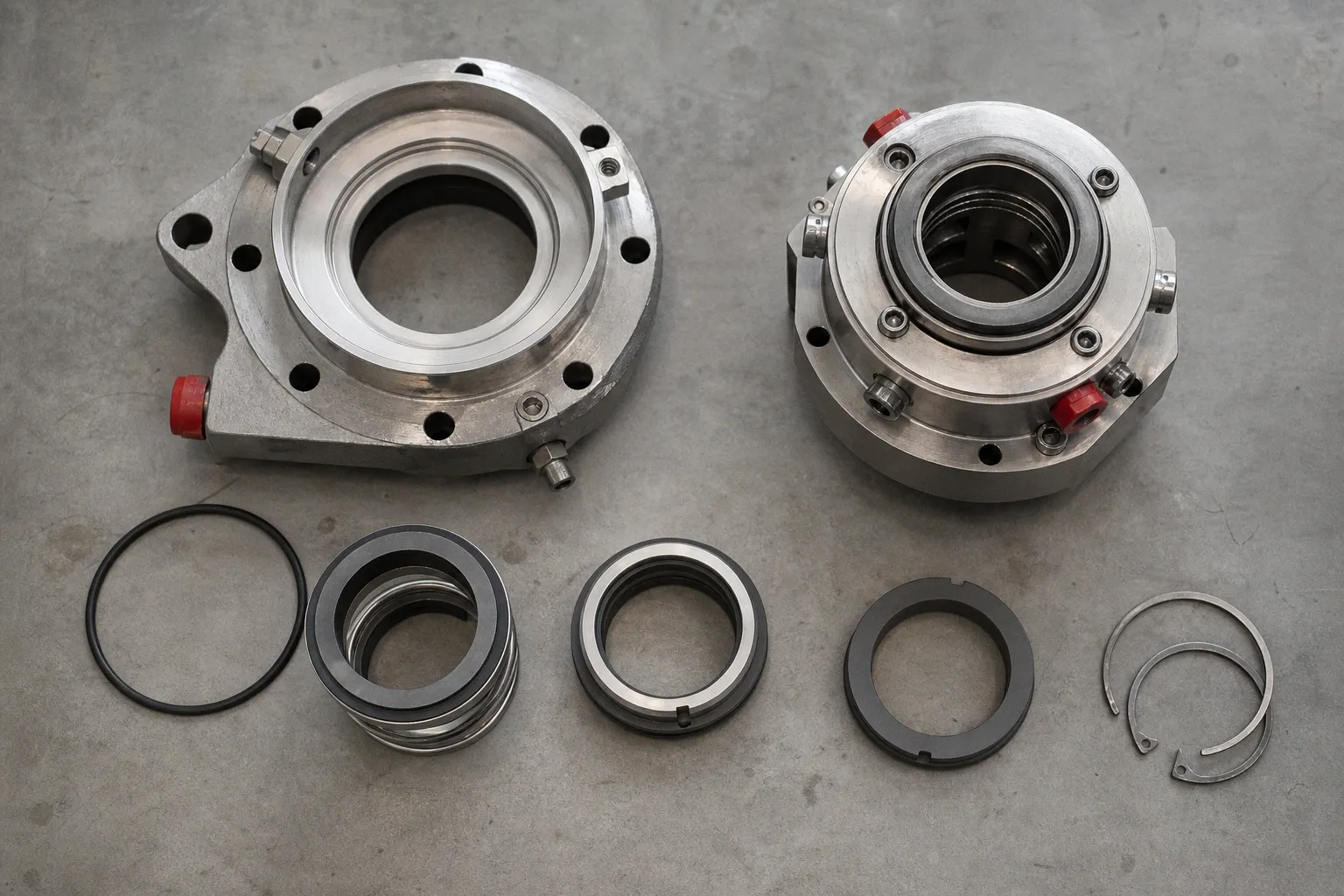
That's not diagnosis. That's lazy taxonomy. A drip is not a verdict — it is data. And if you don't read it correctly, you either throw money at a perfectly functional seal or, worse, you ignore the seal that is about to eat your bearing housing.
There is no universally "allowed" drip rate for industrial pump mechanical seals, no matter how many times a colleague has told you "five drops a minute is fine." The authoritative sources are explicit: API 682 establishes scope and application responsibility; Flowserve and John Crane both treat leakage as a diagnostic event whose meaning depends on the seal arrangement, the fluid, the operating duty, and the vendor's acceptance criteria. So the question — when is a drip a sign of failure? — has one honest answer: it depends, and "it depends" is not a hedge, it's the entire job.
The lubricating film: why "zero leakage" is a myth, and what it costs you to believe it
Let me kill a piece of folklore right now. A mechanical seal does not "seal" by pressing two faces together so hard that no molecule gets through. It seals by holding two extremely flat opposing faces — one rotating, one stationary — close enough that the gap is measured in millionths of an inch, with a thin lubricating film of process fluid between them. That film is the seal. Take it away and you have a brake pad, not a seal. Take it away in real life and you have a hot, ground, scored face that will need replacement in days instead of years.
This is why the industry has never settled on a single acceptable drip rate, and why any vendor who tries to sell you one with a confident number is selling you comfort, not engineering. A seal that runs bone-dry at all times is either over-engineered, starved of cooling, or running at a face combination so hard it has lost its hydrodynamic regime. I have personally seen more seals destroyed by technicians who "fixed" the leak by tightening every adjustment screw in sight than by any other cause on a Flowserve or John Crane troubleshooting sheet.
Counter-point #1: If you are reading a service contract that quotes "zero visible leakage" as the acceptance criterion, you are reading a contract written by someone who has never watched a seal face under load. The reviewed Flowserve inspection guidance says only to verify that shaft-seal leaks are "within acceptable limits" — and immediately couples that check with vibration, noise, bearing temperature, auxiliary supplies, and coupling alignment. That coupling is the giveaway. The OEM isn't telling you to chase a drip; it's telling you to read the system.
The cost of the myth is not theoretical. Every time a tech retightens a mechanical seal's set screws chasing a phantom drip, the faces lose their parallel alignment, the film breaks down, friction spikes, and the very leak you were "fixing" returns — usually in a different place, sometimes as vapor, sometimes as a fine mist that the next shift will misread as "condensation" until the day the bearing housing starts weeping iron-grey grease. The bloat in our maintenance records is full of this story.
A seal does not fail. A seal is failed — by misalignment, dry running, solids, the wrong face combination, or a missed operating point. Replace the part if you must, but the cause you didn't find is the one that's coming back.
API 682 is a scope document, not a leakage ruler
I have watched procurement teams wave an "API 682 compliant" stamp around like it cleared them of any further thought. It doesn't. API Standard 682, Fourth Edition (May 2014) covers shaft-sealing systems for centrifugal and rotary pumps in petroleum, natural-gas, and chemical-industry service. Its stated purpose is to improve reliability, reduce atmospheric emissions, and reduce life-cycle sealing costs. Note the order: reliability first, emissions second. The standard is not a leakage-rate rulebook. It is a classification and qualification framework.
What API 682 actually does for you on a real shop floor is narrower and more useful than the marketing suggests:
| API 682 gives you | API 682 does not give you |
|---|---|
| A shaft-diameter scope: seals for 20–110 mm (0.75–4.3 in.) shafts | A universal drops-per-minute limit |
| A seal-arrangement taxonomy (Category 1, 2, 3 containment plans) | An OEM-independent acceptance rate for any specific fluid |
| A qualification test method for the seal as supplied | A diagnostic procedure for in-service leakage |
| A clear hand-off: "the purchaser and seal vendor must ensure that the selected seal and auxiliaries are suitable for the intended service condition" | Permission to skip the OEM data sheet |
That last row is the one the industry keeps tripping over. The standard explicitly says the responsibility for matching the seal and its support system to the duty belongs jointly to the purchaser and the seal vendor. When something leaks and someone on your team says "API says this is fine" or "API says this is wrong," they have not read the document. They have read a label.
Counter-point #2: If your acceptance criterion for an in-service seal isn't sitting in the OEM pump manual, the OEM seal data sheet, or a written purchase-specification clause, you don't have an acceptance criterion. You have an opinion. Opinions don't hold up in a root-cause failure analysis.
Tracing the true source: before you blame the seal, blame the leak path
This is where bad taxonomy hurts the most, because the cheapest, fastest, and most frequently wrong diagnosis in a pump house is "the seal is leaking." I have personally watched drops migrate along a motor stool, down a coupling guard, off a baseplate drain, and into the gland area that looked exactly like a seal failure. None of them were seal failures.
The visible leak path on a centrifugal pump has more candidates than most checklists admit. Before you call the seal, walk the fluid:
- Seal-face path — the actual interface between the rotating and stationary faces. Drips here are usually accompanied by face wear, heat discoloration, or a fine vapor at start-up.
- Secondary seal — O-rings, wedge gaskets, PTFE element, bellows. Fail here and the fluid bypasses the face entirely; the leak often looks clean because it never crossed the lubricating film.
- Sleeve or shaft joint — set screws, sleeve O-rings, drive notches. A drip that pulses with rotation almost always points here, not at the faces.
- Gland gasket — the static joint between the gland plate and the seal chamber. This is the most misdiagnosed item in the business.
- Piping connections — flush, quench, drain, and plan-port fittings. People see fluid and assume the worst-case component. People who trace first assume less and replace less.
- External sources — leaking pumpage from a relief valve upstream, condensation from a cold pipe crossing overhead, a hydraulic fitting two meters away that nobody noticed.
John Crane's own list of root causes for a pump-seal leak includes poor lubrication, incorrect installation, incorrect seal selection, unexpected operating conditions, contamination, and misalignment. Notice that none of those say "the seal is bad." They say the seal was put into a bad situation, and it told you about it.
Counter-point #3: If your team replaces a mechanical seal without checking installation dimensions, face flatness, set-screw torque, and the alignment of the seal chamber to the shaft, you have not maintained a pump. You have replaced a symptom and left the cause untouched.
Diagnostic indicators: what your drip is actually trying to point at
A drip is a symptom. The disease is somewhere upstream in the seal-support system. Flowserve's troubleshooting manual lists the usual suspects in plain English: incorrect seal type for the duty, shaft runout from worn bearings or misalignment, impeller imbalance and vibration, abrasive solids, dry running, and internal misalignment after improper repair. Read that list again. Six items, and only one of them is a property of the seal itself. The other five are properties of the pump and the process.
This is the diagnostic order I use, every time:
1. Vibration — broadband rise, especially at the 1× shaft and the vane-pass frequencies, tells me the seal is riding a moving target. The faces cannot track a shaft that is wandering.
2. Shaft runout and bearing condition — measured at the seal chamber, not at the motor. A worn bearing on the inboard end means the seal face is being orbited; the film keeps breaking and reforming.
3. Dry-running history — even seconds of dry running will glaze the faces. If the operator says "it was fine until we lost the level," the seal is a casualty, not a cause.
4. Solids and contamination — abrasive particles in the flush fluid will sandblast the soft face. Check the strainer and the flush pressure differential before anything else.
5. Operating point — running a centrifugal pump far right of its BEP loads the seal with axial thrust it was never qualified for. The seal wasn't wrong; the operating point is.
6. Installation dimensions — L-bracket length, gland bolt torque sequence, sleeve position. These are measured with a ruler, not with a hammer.
Counter-point #4: A maintenance ticket that says "replace seal, leak at gland" without recording vibration, runout, flush pressure, and the last-known operating point is not a work order. It is a confession that nobody intends to learn anything from this failure.
If your acceptance criterion for a mechanical seal is something you heard in a break room, it isn't engineering — it's folklore wearing a hi-vis vest.
Regulatory screening versus operational limits: keep 40 CFR 261.1058 in its lane
This is the part of the conversation that gets mangled the most, and I have seen it mangled by people who should know better. Under 40 CFR 261.1058, certain pumps and valves in heavy-liquid service are subject to a specific U.S. regulatory monitoring regime. The numbers are real and worth knowing in their proper context:
- Evidence of a potential leak — found by visual, audible, olfactory, or any other detection method — triggers monitoring within five days.
- An instrument reading of 10,000 ppm or greater is defined as a detected leak.
- The first repair attempt must be made within 5 days of detection, and repair must be completed as soon as practicable, generally no later than 15 calendar days after detection.
Now read those numbers again and tell me what they have to do with your seal's drip rate. The answer is: nothing, directly. 40 CFR 261.1058 is an emissions-monitoring threshold for specific regulated equipment under a specific U.S. regulatory provision. It is not an acceptable operating rate for a mechanical seal. Conflating the two is exactly the kind of corporate noise that gets a leak ignored because "it's only at 9,000 ppm" and gets a perfectly good seal scrapped because someone read 10,000 ppm and panicked at a routine visible leakage vs vapor emission reading.
| Regulation (40 CFR 261.1058) | What it actually means |
|---|---|
| Investigate evidence of a leak within 5 days | A scheduling rule for inspectors, not a diagnostic standard |
| 10,000 ppm is a "leak" | A screening threshold for specific regulated pumps/valves, not a drip rate |
| Repair within 15 calendar days, first attempt within 5 | A compliance deadline once the threshold is confirmed |
The rules do not establish how much leakage is "normal" in a healthy seal. The rules establish how much leakage you must formally acknowledge and act on in a particular regulated service. Different jurisdiction, different fluid, different facility category — different rule, possibly none at all. Do not borrow a regulatory threshold to fill the gap left by a missing OEM acceptance criterion. That is over-engineered paperwork covering under-engineered judgment, and it will bite you in the next audit.
Putting it together: when is a drip actually a sign of failure?
Here is the blunt verdict, in the voice I want this whole site to use.
A drip is a sign of failure when it is changing, when it is accompanied by other symptoms, or when it exceeds the OEM- or vendor-specified acceptance criterion for that seal, that fluid, and that duty.
A drip is not a sign of failure when it is steady, within the written acceptance criterion, and matched with normal vibration, normal bearing temperature, and normal seal-chamber temperature. A small, steady weep on a hot seal can be the lubricating film doing its job and finding its way out through the secondary containment. That is design, not failure.
Do this, not that.
- Do treat every visible drip as a diagnostic event. Record the rate (drops per minute is fine as an internal label — just don't promote it to a universal limit), the temperature, the vapor signature, the vibration trend, and the last operating point.
- Do pull the OEM pump manual and the seal data sheet before forming an opinion. If the vendor doesn't have one for your exact service, write the acceptance criterion into the purchase spec yourself. Don't outsource the thinking.
- Do check shaft runout, alignment, bearing condition, flush pressure, and dry-running history before condemning the seal. Five checks, ten minutes, often cheaper than the seal you were about to install.
- Don't tighten a mechanical seal's hardware to stop a drip. It isn't packing. The faces need their geometry, and your gland bolts were already torqued at install.
- Don't cite API 682 as if it set your drip limit. It didn't. Cite the data sheet.
- Don't cite 10,000 ppm as if it told you how your seal should run. It told you what your regulator wants you to do about a confirmed leak in a specific service. Different question.
- Don't replace the seal and walk away. If you didn't trace the cause, you queued the next failure.
Closing
The whole industry has built a small mountain of folklore around the mechanical seal drip. Most of it is noise. A small amount of it is useful, when it is written down and applied to the specific seal, the specific fluid, the specific shaft, and the specific duty in front of you. API 682 gives you scope and qualification; Flowserve and John Crane give you diagnostic lists; 40 CFR 261.1058 gives you a regulatory calendar. None of them give you a number to post on the wall.
The work, then, is what it has always been. Read the manual. Trace the source. Measure the support conditions. Record the change. And stop calling a steady, in-spec weep a "failure" just because the next shift doesn't like the look of it. That's not a seal problem. That's a taxonomy problem — and we know what to do with those.