Mechanical seals vs gland packing: choosing the right pump seal
Picture, for a moment, the operator standing at the end of a long shift. The pump has been running for nine hours straight, and somewhere behind the coupling guard there is a slow, steady hiss.
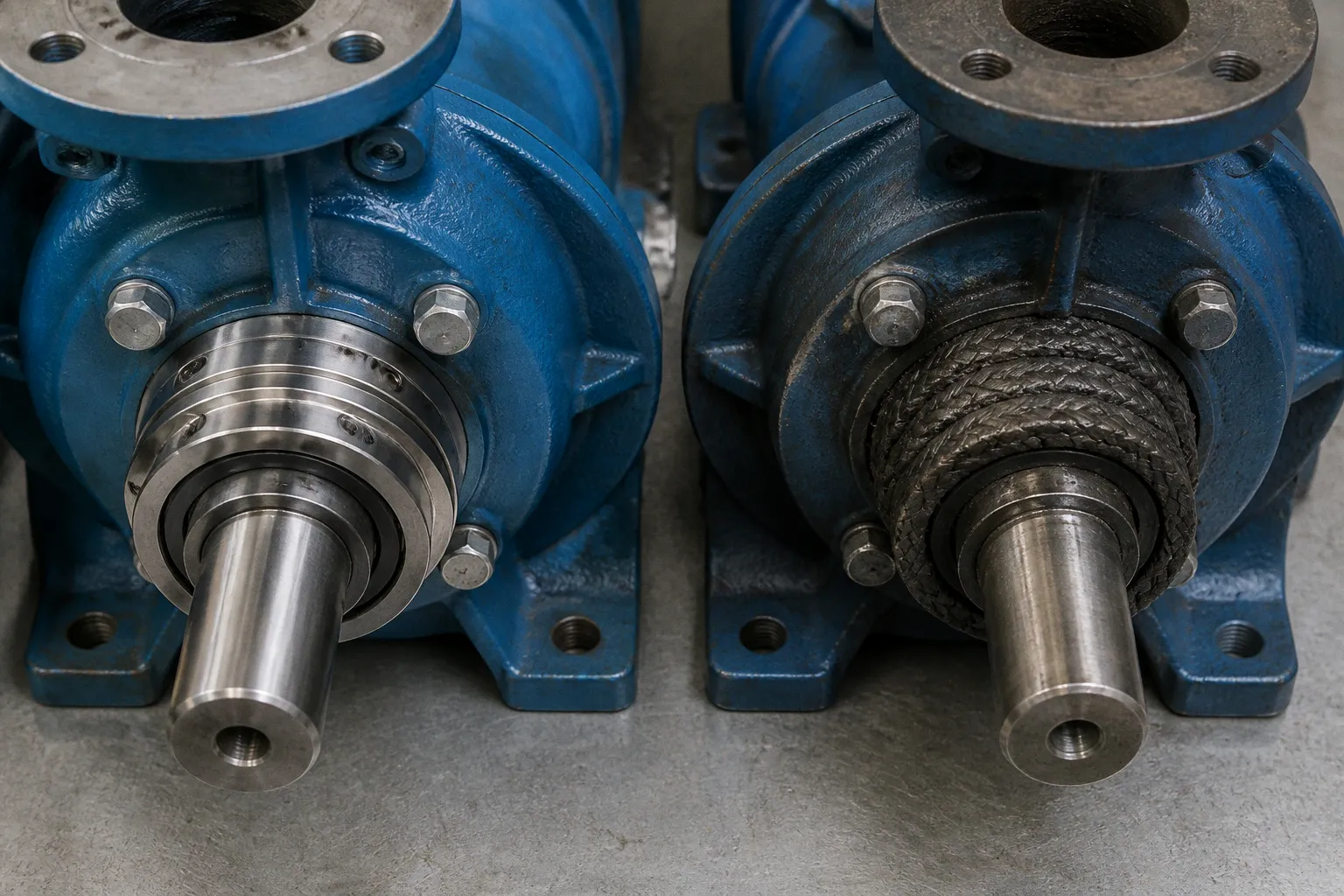
They are holding a wrench, deciding whether to give the gland follower one more quarter-turn — the kind of small, almost instinctive decision that repeats itself dozens of times across a maintenance career. That hiss, that wrench, that moment of judgment: this is where the real-world conversation between gland packing and mechanical seals actually lives. Not in a spec sheet, not in a vendor brochure, but in the repetitive, tactile work of keeping a pump online. So when we sit down to compare the two technologies on the factory floor, we are really comparing two different relationships between the operator and the machine — and two different answers to the question of how much leakage a process can tolerate.
Compare car rental deals in United Kingdom
See available offersPartner link — DiscoverCars comparisonThe mechanics of sealing: how leakage differs in practice
Let us start with the basic physical difference, because once you understand it, almost everything else falls into place. Gland packing is a layered stack of braided or molded rings — typically a blend of fibers such as PTFE, graphite, aramid, or flexible graphite composites — pressed into a stuffing box around the shaft by a gland follower. It is a soft, conforming barrier. It does not actually seal by squeezing the shaft completely; it seals by trapping enough liquid in its weave to build a thin lubricating film, and that controlled leakage is what keeps the packing cool and alive. If you tighten the gland until the drips disappear, you have not fixed the seal — you have starved it of lubrication, the friction climbs, the temperature rises, and the shaft sleeve starts to wear. That is a lesson most of us on the ground learned the hard way, usually on somebody else's pump.
Mechanical seals, by contrast, work on a fundamentally different principle. Two precision-finished faces — one stationary, one rotating against it — ride on a microscopically thin film of process fluid. That film is the lubricant; without it the faces would gall in seconds. The geometry is tight, the tolerance is on the order of microns, and the leakage is measured not in liters per hour but in cubic centimeters per hour. In one widely cited KSB comparison of a volute-casing pump running at a 20 m/s shaft-sealing speed and 15 bar sealing pressure, gland packing leaked roughly 5–8 L/h while a properly functioning mechanical seal leaked in the neighborhood of 6 cm³/h, or 0.006 L/h. The difference is enormous — about three orders of magnitude — and on a paper comparison that is the headline number.
On the ground, the choice is rarely "sealed versus unsealed." It is "how much leakage can your process, your operator, and your environment actually live with?"
But the KSB comparison applies only to that specific pump, that specific speed, that specific pressure. Translate those numbers onto a different shaft diameter, a different fluid, a different face material, and the gap closes or widens. Mechanical seals are not zero-leakage devices — they depend on a thin film at the face interface, and a small amount of function-related leakage is not only acceptable, it is necessary. A rising leakage rate over time is a tell that the faces are wearing, the elastomers are taking a set, or the alignment has drifted. So when we say "mechanical seals leak less," we are really saying "they leak predictably less, in a narrower band, when everything else is right." That caveat matters enormously when you are specifying, because the operating envelope that produces those clean numbers is narrower than the marketing literature suggests.
| Parameter | Gland packing | Mechanical seal |
|---|---|---|
| Typical leakage (lab comparison) | 5–8 L/h (KSB, 20 m/s, 15 bar) | ~6 cm³/h under similar conditions |
| Operating principle | Controlled leakage through woven fibers lubricates and cools the packing | Thin fluid film between two lapped faces maintains a near-contact seal |
| Tolerance for dry running | Poor — lubrication is the leakage itself | Poor — faces require continuous fluid film |
| Sensitivity to shaft run-out | Moderate | High — face geometry depends on concentricity |
| Sensitivity to abrasive particles | Tolerates some abrasives when fluid flushes them out | Vulnerable — particles score the faces |
| Adjustment while running | Yes — gland can be retorqued | No — adjustment requires shutdown and rebuild |
| Typical service access | Side-entry stuffing box, often adjustable in place | Seal chamber, often requires pump removal on conventional designs |
Operational realities: maintenance cycles and adjustment protocols
This is where the two technologies diverge most sharply in operator experience, and where operator fatigue becomes a design constraint rather than a personal complaint. With gland packing, the maintenance rhythm is small, frequent, and tactile. An operator walks past the pump, sees a drip rate that has wandered outside the expected band, takes a wrench to the gland nuts, and gives them a measured half-turn. Metso's own guidance is to make that adjustment gradually — over the course of several hours, not in one decisive grab — so the packing can bed in evenly against the shaft sleeve. They are explicit that overtightening causes severe shaft-sleeve wear, which is the long-term failure mode of a packing system that has been muscled rather than managed.
What that protocol actually means on the ground is a recurring, low-stakes piece of work distributed across many operators over the life of the pump. The seal is not a single catastrophic event; it is a steady drip of small interventions. Some plants love this, because the seal is forgiving, the spare rings are cheap, and a skilled operator can tune a packed stuffing box by feel. Other plants hate it, because the leakage hits the floor, the emissions limits, the washdown water, and the operator's boots.
Mechanical seals flip that rhythm entirely. The seal is built to run for long stretches without intervention — John Crane describes typical mechanical seal life in terms of years rather than months, though that figure is heavily qualified by fluid, temperature, installation quality, and maintenance practice. The tradeoff is that when a mechanical seal does fail, it usually fails decisively, and the fix is rarely a quarter-turn of a wrench. On a conventional mechanical seal, replacement commonly requires taking the pump out of service and accessing the seal chamber, which on many overhung process pumps means pulling the back pull-out assembly or even the whole rotating element. That is hours of downtime, not minutes.
The notable exception is the split mechanical seal, which can be installed without dismantling the equipment it seals — a real-world lifesaver on large pumps where full disassembly is impractical. We have seen split seals earn their keep on slurry pumps and on equipment with limited overhead clearance, where the alternative is a multi-day outage. But split seals are a specific tool, not a universal upgrade path, and they introduce their own alignment sensitivities that the operator must learn.
If the operator is the design constraint, then the seal choice is also a choice about who carries the maintenance burden — every shift, every quarter-turn, or once every few years in a controlled outage.
When to prioritize gland packing for abrasive and simple duties
There is a temptation, especially in clean, modern facilities, to treat gland packing as legacy technology — a relic of an era before face seals became reliable. That is wrong, and it costs plants money. Gland packing remains the right answer in a real set of operating conditions, and a maintenance engineer who reaches for a mechanical seal in those services will usually regret it.
Abrasive service is the classic case. Mineral slurries, paper stock, lime slurry, bottom ash — fluids that carry fine solids which would happily score a mechanical seal face in a matter of hours. Packing, with its conformable fiber structure, can tolerate a certain amount of particulate because the leakage flushes debris outward before it can embed. A mechanical seal face has nowhere to hide; once a particle gets between the lapped surfaces, the damage propagates. We have walked onto floors where a perfectly good pump was eating mechanical seals every six to eight weeks because someone had specified the wrong technology for the service, and the cost of conversion back to packing was paid for in lost production.
There is also the simplicity argument. Packing does not require flush water, barrier fluid, or a plan 52 / plan 53 support system. It does not need a clean cooling circuit. It can be installed with a puller, a lantern ring, and a torque wrench, often without removing the bearing frame. For remote sites, for older pumps scheduled for replacement anyway, and for duties where the cost of a seal support system outweighs the cost of acceptable leakage, packing is the engineering-correct answer. Lower initial cost, adjustable in place, tolerant of misalignment — these are not weaknesses, they are features matched to the duty.
The honest limitation is leakage. In services where the pumped fluid is hazardous, flammable, toxic, or environmentally regulated to near-zero emissions, packing's drips per hour become a compliance problem rather than a maintenance convenience. That is the line, and we have learned to draw it early in the project rather than during commissioning.
Engineering for reliability: applying API 682 standards
Once a process crosses into hazardous-service territory — petroleum, natural gas, certain chemical duties, anything flammable or toxic — the conversation leaves the workshop and enters the standards library. API Standard 682 is the reference document for shaft-sealing systems on centrifugal and rotary pumps in those services, and the fourth edition dated May 2014 covers pump-shaft diameters from 20 mm (0.75 in.) up to 110 mm (4.3 in.). The standard is referenced normatively inside API 610 and is also applied to certain non-API 610 pumps where the duty justifies it. It is important not to overstate its reach: API 682 is built around the realities of hazardous-service centrifugal and rotary pumps, not every industrial pump on the floor.
Inside the standard, the taxonomy of seal arrangements is the practical tool a maintenance engineer reaches for. The three families are single seals, dual unpressurized seals, and dual pressurized seals, and each maps to a different tolerance for leakage to atmosphere.
- A single seal is one set of faces in one chamber — simplest, cheapest, but anything that passes the faces goes straight to the environment.
- A dual unpressurized arrangement pairs two seals with an unpressurized buffer between them; leakage past the inboard seal is captured and routed away rather than released, useful for poorly lubricating or mildly hazardous fluids.
- A dual pressurized arrangement maintains a barrier fluid at a pressure above the process, so any leakage is inward from the barrier side — the configuration for the most hazardous services, where leakage must be contained and isolated from the atmosphere.
The standard also touches on the operational envelope that makes these seals work: cooling, flush, buffer, and barrier systems. Mechanical seals do not survive on optimism; they need the support systems the standard describes, or they fail in the same predictable ways every time.
API 682 is not a purchase order for "the best seal." It is a vocabulary for matching seal architecture to the duty — and the operator is the one who lives with that vocabulary.
Evaluating the transition: factors for upgrading to mechanical seals
When the conversation turns to upgrading an existing packed pump to a mechanical seal, we treat it as an engineering project, not a parts swap. The if-then framing is useful here, because it forces every assumption to the surface before the pump is opened.
If the process fluid is hazardous or regulated, then the leakage from packing is no longer acceptable and a single mechanical seal — or more likely a dual arrangement under API 682 — becomes the path forward.
If the process is abrasive but not hazardous, then packing probably stays and the upgrade question is reframed: maybe the right move is better packing rings, a flush water connection, or a different sleeve material, not a face seal.
If the pump is a small, overhung unit with a generous stuffing box, then a conventional mechanical seal may fit without modification. If the pump is a large, heavy-duty machine with a tight seal chamber and high shaft run-out, then a conventional seal may be a poor fit and a split seal or a custom cartridge design becomes the realistic option.
We also walk through the operating envelope that the new seal will inherit, because a face seal will not paper over the problems a packing system was masking. Selection must account for the pumped fluid, pressure, temperature, shaft speed, shaft movement or run-out, material compatibility, installation quality, and the availability of cooling, flush, buffer, or barrier systems. A seal specified for a clean, cool, lubricating fluid will not survive in a hot, viscous, particle-laden one, regardless of how careful the lapping was. And the seal chamber itself has to be the right size and concentric; stuffing-box dimensions that worked for packing are not automatically the right home for a mechanical seal cartridge.
We have a final rule on conversions, drawn from the maintenance bench rather than the catalog: do not recommend a conversion from packing to a mechanical seal without verifying the seal-chamber dimensions, the shaft or sleeve condition, the available flush, and the maintenance procedure for replacing the new seal. A seal that cannot be replaced in the time the plant can afford to lose is a seal that will not get replaced when it needs to be, and the savings on leakage will be paid back in unplanned downtime.
Living with the seal you chose
We close where we opened — at the pump, with the operator, with the wrench or the work order. The mechanical seal versus gland packing question is not a moral one. It is a design decision about how a piece of equipment should live inside a working day, and every choice has a downstream consequence for the person who has to keep it alive.
A well-specified gland packing, adjusted gradually and honestly, gives the operator a relationship with the pump that is tactile, forgiving, and continuous. A well-specified mechanical seal, supported by the right flush and barrier systems and installed inside a chamber that was designed for it, gives the operator something closer to a quiet long-term partnership — years of steady running with only the occasional planned intervention. Either way, the right answer is the one that matches the fluid, the duty, the maintenance culture, and the regulatory environment, and that the people on the ground can actually keep alive through the next thousand shifts.