Zinc plating or hot-dip galvanizing for industrial fasteners?
“Galvanized” is not a usable fastener specification. It is a word people put on purchase orders when they want corrosion resistance but have not decided how much, where, or at what assembly cost.
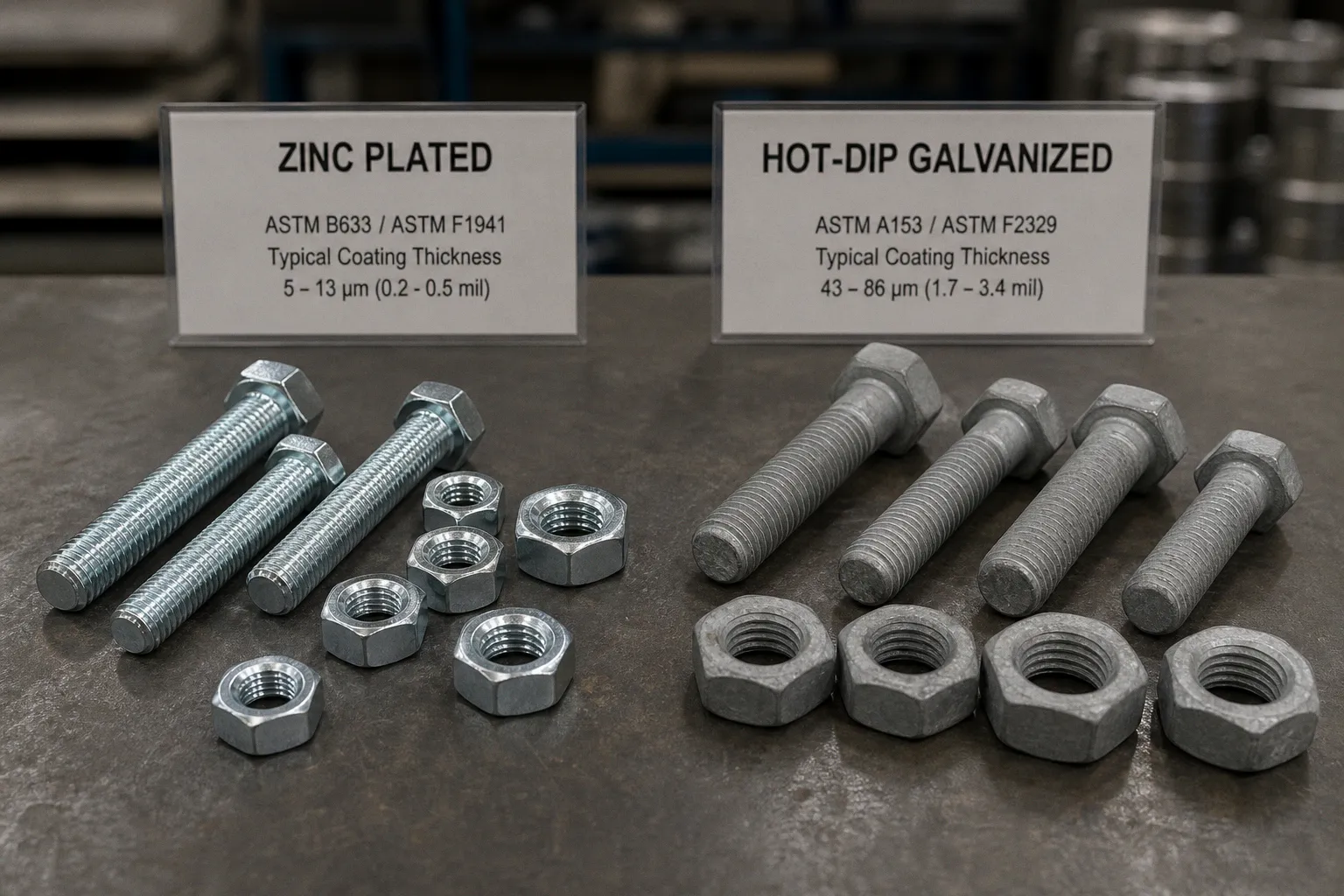
I see this failure pattern constantly: a maintenance team replaces plain bolts with “galvanized” hardware for an outdoor conveyor, pipe rack, guardrail, or pump skid. The order arrives. Some bolts will not mate with the nuts. Torque values drift. A high-strength component gets sent through the wrong coating process. Then somebody blames the supplier for a decision that was never actually specified.
For zinc plating vs galvanizing for industrial bolts, the choice is not subtle. Zinc plating gives a thin, controlled electrodeposited finish for relatively mild exposure and small hardware. Hot-dip galvanizing gives a much heavier zinc coating for tougher corrosion service—along with more dimensional baggage. Calling them equivalents is how procurement creates friction for assembly and noise for everyone else.
The coating is not an accessory. On a threaded fastener, it is part of the geometry, the corrosion strategy, and sometimes the failure mode.
Zinc plating and hot-dip galvanizing do different jobs
Start with the process, because the catalog language often muddies it.
Zinc plating is electrodeposition. The steel fastener goes into an electrolytic bath, and zinc deposits onto the surface. The result is usually thin, smooth, and dimensionally manageable. Typical plated-fastener coatings fall around 0.2–0.5 mil, or roughly 5–13 µm.
Hot-dip galvanizing, often shortened to HDG, immerses prepared steel in molten zinc. For threaded fasteners, the coating process and spin-off operation produce a far thicker zinc layer. Under ASTM A153, small fasteners below 3/8 inch diameter have a minimum average coating thickness of 1.7 mil, or 43 µm. Fasteners larger than 3/8 inch move to a 2.1 mil, or 53 µm, minimum average. Depending on product class and size, hot-dip coating can run much thicker—commonly in the 43–86 µm range.
That is not a minor increment. A typical HDG coating can be several times thicker than zinc plating. It changes what the fastener can survive outdoors, and it changes how the threads need to work.
| Parameter | Zinc-plated fastener | Hot-dip galvanized fastener |
|---|---|---|
| Coating process | Electroplated zinc deposition | Immersion in molten zinc |
| Typical coating range | About 5–13 µm | About 43–86 µm, depending on item and class |
| Surface character | Thin and relatively smooth | Thick, more variable, more robust |
| Thread effect | Usually limited dimensional impact | Requires deliberate thread-clearance strategy |
| Best fit | Indoor equipment, controlled environments, low-to-moderate exposure | Outdoor steelwork, wet or industrial exposure, long-life corrosion protection |
| Assembly risk | Lower if grade and plating controls are correct | Higher if bolts, nuts, torque method, and threads were specified independently |
I am not arguing that every outdoor bolt needs HDG. That would be another lazy rule. A zinc-plated M6 panel screw inside an enclosed machine cabinet does not need the same treatment as a structural clamp bolt sitting above a chemical washdown area for ten years.
But the reverse error is far more common: teams choose plating for outdoor machinery fastener protection because it looks bright in a catalog photo. Bright is not a corrosion category.
Thickness is the point—not a decorative detail
People like to compare coatings by color: blue-white zinc, yellow passivate, dull gray galvanizing. That is visual shorthand, not engineering.
The meaningful distinction is zinc mass and coating thickness. More zinc generally gives more sacrificial material between the steel substrate and the environment. But the useful life of that protection still depends on exposure, mechanical damage, crevices, drainage, contaminants, and the condition of the joint itself.
A bolt on a dry warehouse racking frame and a bolt under a cooling-tower platform do not live in the same world. Neither does a fastener on a road-salt-exposed truck chassis and one on a sheltered agricultural machine.
The standards make the distinction clearer than most distributor descriptions do:
- ASTM B633 covers electrodeposited zinc coatings on iron and steel for corrosion protection. For mechanical fasteners, it points buyers toward ASTM F1941/F1941M.
- ASTM F1941/F1941M covers electrodeposited coatings on threaded mechanical fasteners, including coating thickness, conversion finishes, corrosion resistance, and hydrogen-embrittlement controls.
- ASTM A153/A153M addresses hot-dip zinc coatings on iron and steel hardware.
- ASTM F2329/F2329M is the fastener-specific standard for hot-dip zinc coating on carbon- and alloy-steel bolts, screws, nuts, washers, and other threaded hardware.
- ISO 4042 covers electroplated coating systems for fasteners.
- ISO 10684 covers hot-dip spun galvanized coarse-threaded steel fasteners from M8 to M64, within its stated property-class limits.
That list is not standards theater. It tells the buyer where the real controls sit.
A line item that says only “zinc plated hex bolt” leaves too much open: coating designation, actual thickness, passivation, supplementary treatment, baking requirements, corrosion-test criteria, and thread compatibility may all be absent. “Galvanized bolt” can be equally vague. It could mean hot-dip galvanized, mechanical zinc coating, zinc flake, or whatever a seller thinks will close the search filter.
Do this: request the coating process and governing specification.
Not this: assume “zinc” and “galvanized” mean the same thing because both parts look silver.
For high-volume machine builds, I want the drawing or purchase specification to tie the part to a standard and a defined coating class. For maintenance spares, I still want the supplier to state what is actually being supplied. A generic catalog adjective is not inspection data.
HDG bolt clearance issues are predictable, not mysterious
The thick coating that makes hot-dip galvanizing attractive also creates its most obvious assembly problem: threads have no interest in your vague intent.
A hot-dip galvanized bolt must usually mate with a galvanized nut that has been tapped oversize. The zinc on the male thread consumes clearance. If the nut keeps standard internal dimensions, the pair may seize, gall, or simply refuse to assemble. This is not a quality defect. It is basic geometry.
The common bad move looks like this: someone specifies HDG bolts for an exposed platform, then sources ordinary zinc-plated nuts from stock because they are cheaper and available. The result is a mixed system with uncertain fit. That uncertainty turns into rework on site, which costs much more than the correct nuts did in the first place.
Published design allowances illustrate the scale of the issue. A 1/4-20 nut may need roughly 0.016 inch of diametral allowance for galvanizing. A 1/2-12 nut may need about 0.018 inch. A 1-8 nut may need around 0.024 inch. The exact allowance is not a field improvisation exercise; it belongs in the standard, the supplier’s process controls, and the matching hardware system.
What I check before approving HDG threaded hardware
1. Bolt and nut as a matched system. I do not approve an HDG bolt and let someone “find a nut later.” The nut coating, oversize tapping, property class, and intended preload all belong in the same conversation.
2. Thread series and size. ISO 10684 applies to coarse-threaded steel fasteners from M8 through M64. It does not recommend hot-dip galvanizing below M8 or for pitches below 1.25 mm. Fine threads and tiny diameters are where an over-engineered corrosion choice becomes a dimensional headache.
3. Washer coverage and bearing surfaces. A heavy zinc coating affects more than the threads. It changes contact surfaces, stack height, and the way a joint beds in under load. On critical joints, treating washers as anonymous commodity rings is a reliable way to create torque scatter.
4. The actual assembly method. Impact installation, prevailing-torque nuts, lubricated systems, and controlled-tension procedures do not react identically to coated hardware. I do not borrow a torque figure from an uncoated bolt chart and call it done.
5. Field replacement logic. If a machine will be serviced years later, the maintenance manual and spares list must prevent a technician from mixing coated and uncoated mating parts. A good initial design that cannot survive routine maintenance is not good design.
Hot-dip galvanizing solves corrosion exposure only if the joint still assembles as a joint.
There is another temptation worth killing: “We can chase the threads after galvanizing.” Sometimes a process may include thread work under controlled conditions, but casual shop correction is not a universal rescue plan. Strip zinc from the wrong places, damage the coating, alter engagement, or introduce a mismatched nut, and the corrosion story changes fast.
High-strength fasteners need a different conversation
Corrosion protection does not outrank mechanical integrity. It never has. Yet I still find plated high-strength fasteners specified with the casual confidence usually reserved for office furniture.
Both electroplating and hot-dip galvanizing require attention to hydrogen embrittlement. The mechanisms and control points differ, but the practical message is blunt: do not treat high-strength, heat-treated fasteners as ordinary steel parts.
For electroplated zinc, ASTM B633 says steels above 1,700 MPa tensile strength—247 ksi, or 46 HRC—should not be zinc electroplated under that specification. ASTM F1941 addresses hydrogen-embrittlement risk controls for coated mechanical fasteners, but a specification is not a magic wand. The buyer still has to know the fastener grade, hardness, heat-treatment condition, and whether the coating process fits the application.
Hot-dip galvanizing has its own warning zone. Guidance associated with ASTM A153 flags high-tensile fasteners above 150 ksi as potentially susceptible. Again: not every high-strength bolt will fail, and not every project must avoid HDG. But neither process earns a blanket approval because someone added the words “high strength” to a catalog title.
The failure can be ugly. Hydrogen embrittlement often does not announce itself at assembly. The fastener tightens, the crew leaves, and delayed cracking appears later under sustained stress. By then, the purchasing shortcut has become a root-cause investigation.
This is where I become deliberately annoying in reviews. If the fastener carries high preload, experiences cyclic load, secures rotating machinery, or sits in a safety-critical restraint, I ask for more than a finish callout. I want to know:
- the bolt’s property class or grade and documented tensile range;
- whether it was heat treated;
- the applicable coating standard and process route;
- the supplier’s embrittlement-relief or process-control approach where relevant;
- the mating nut and washer configuration;
- the intended tensioning method;
- whether the design team has approved the coating for that exact joint.
That sounds like bureaucracy only to people who have never had to remove fractured bolts from a pump baseplate at 2 a.m.
Do not convert salt-spray hours into years of service
Salt-spray results are useful as comparative process data under a stated test method. They are not a crystal ball.
I have watched teams take a catalog claim—say, a number of hours to red rust—and translate it directly into years of field life. That is false precision with a spreadsheet attached. The American Galvanizers Association notes that accelerated salt-spray testing does not produce results consistent with real-world zinc-coating performance.
The reason is straightforward. Field corrosion depends on conditions a salt-fog chamber does not fully reproduce:
- wet-dry cycling and time of wetness;
- chlorides from road salt, marine air, or process chemicals;
- acidic or alkaline washdown;
- trapped moisture at lap joints and under washers;
- abrasion from vibration, tool contact, or moving equipment;
- coating damage during transport and installation;
- dissimilar-metal contact and local galvanic effects;
- drainage, orientation, and whether the hardware can actually dry.
A plated fastener may perform perfectly well in a dry indoor production cell and look ridiculous after a season on exposed equipment near de-icing salts. An HDG fastener may carry the corrosion side of the brief outdoors, yet be wrong for a fine-threaded, high-strength, tightly controlled machine joint.
This is why “fastener corrosion resistance levels” should not be reduced to a traffic-light chart. The real question is: what will this joint see, and what failure hurts first? Cosmetic staining? Loss of clamp load? Thread seizure during maintenance? Structural section loss? Delayed brittle fracture?
Those are different problems. They need different answers.
A practical selection route for industrial hardware
When I audit a fastener specification, I do not start with the finish. I start with the joint and work outward.
Choose zinc plating when:
- the hardware is small, fine-threaded, or dimensionally sensitive;
- the exposure is indoor, enclosed, or otherwise controlled;
- the assembly needs a thin coating with minimal thread disruption;
- the fastener strength and plating process have been screened for embrittlement risk;
- the coating requirement can be tied to ASTM B633, ASTM F1941, ISO 4042, or the relevant project standard.
Choose hot-dip galvanizing when:
- the hardware faces outdoor, wet, industrial, or otherwise aggressive corrosion exposure;
- the fastener geometry and thread size can accommodate a thicker coating;
- bolts, nuts, and washers are specified as a compatible galvanized system;
- the joint does not rely on casual torque assumptions borrowed from uncoated hardware;
- the selected grade, tensile strength, and galvanizing process have been assessed for embrittlement concerns;
- the specification points to ASTM A153, ASTM F2329, ISO 10684, or the controlling project requirement.
There are cases where neither is the clean answer. Highly corrosive chemical environments, extreme temperature service, severe cyclic loading, or high-strength precision assemblies may push the design toward stainless alloys, zinc-flake systems, mechanically deposited coatings, duplex approaches, or a redesigned joint. I do not say that to inflate the solution space. I say it because forcing every problem into “plated or galvanized” is procurement taxonomy pretending to be engineering.
The verdict: specify the joint, not the shine
Zinc plating is thin, orderly, and useful. Hot-dip galvanizing is thick, durable, and unforgiving of sloppy thread planning. Neither finish is automatically superior. Each becomes a bad choice when somebody strips away the operating context and buys by label.
My blunt rule is simple: use zinc plating for controlled exposure and tight dimensional needs; use hot-dip galvanizing for genuinely demanding corrosion exposure where the complete mating hardware system has been designed for it.
Do not write “galvanized bolt” and hope the supplier reads your mind. Do not pair an HDG bolt with whatever nut is on the shelf. Do not plate a high-strength fastener because the catalog made it look routine. And do not let salt-spray hours impersonate field life.
Specify the coating process, the governing standard, the fastener grade, the mating hardware, and the exposure. Everything else is bloat—and bloat is expensive when it turns into seized threads, cracked bolts, and a shutdown crew waiting on the right hardware.