Threadlockers or lock washers for high-vibration joints?
The split lock washer is a lie. Not a dramatic lie — not the kind that gets somebody fired — but a quiet, decades-old engineering lie that has survived because nobody wants to be the supply chain manager who removes a familiar part from the BOM.
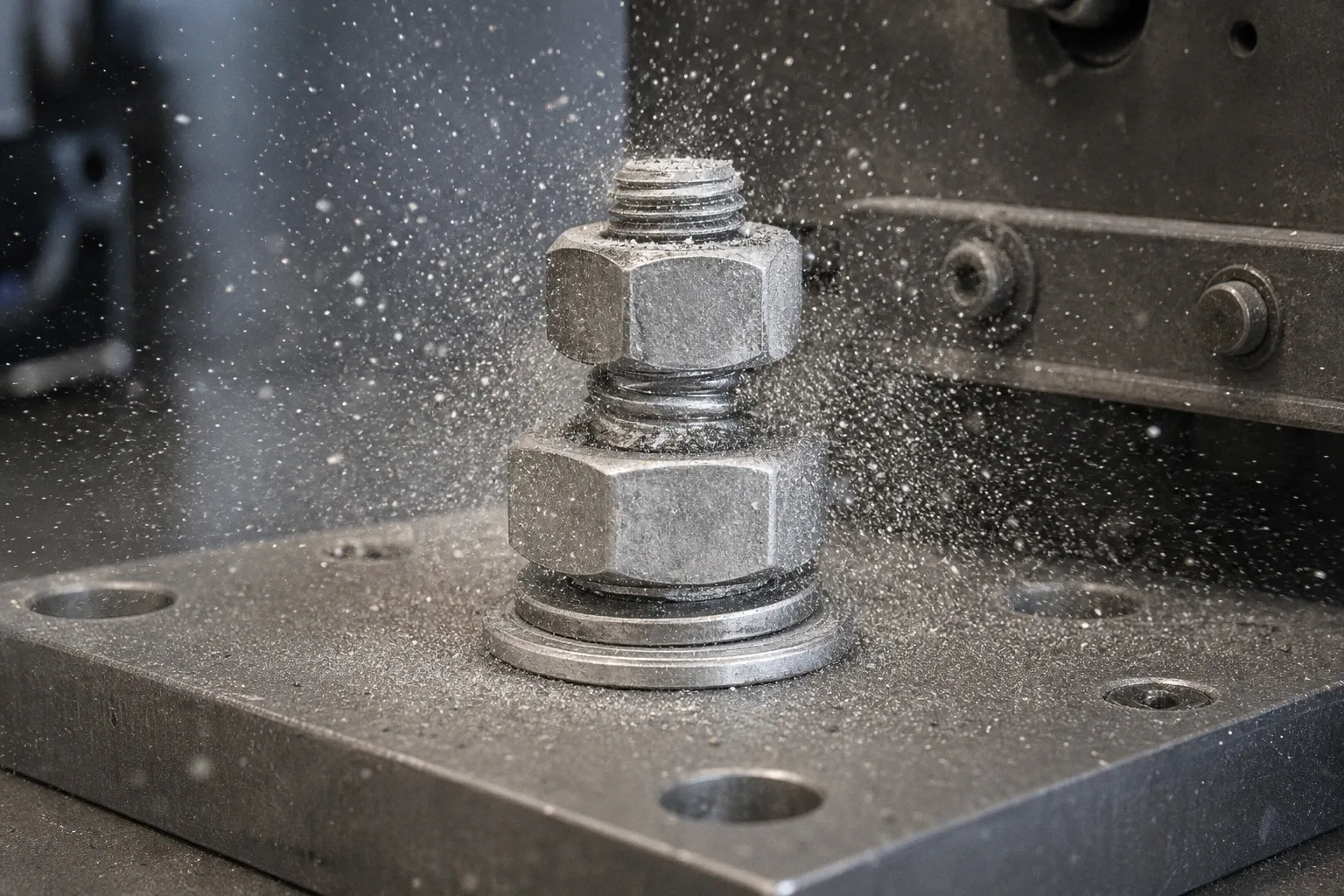
If you have spent any time on a shop floor or in a maintenance audit, you have seen it: a tote of DIN 127 helical split washers, ordered in bulk, installed on everything from pump housings to conveyor drive couplings, providing roughly the same amount of vibration resistance as a plain flat washer. Which is to say, none.
Compare car rental deals in United Kingdom
See available offersPartner link — DiscoverCars comparisonThe problem is not that every split washer causes an immediate failure. The problem is that it creates the appearance of a locking system without reliably preserving the thing that keeps a bolted joint tight: clamp load. Once transverse vibration makes the joint faces slip against one another, the bolt can rotate loose. A washer that has flattened under preload and has no dependable mechanism left to resist that rotation is not a vibration solution. It is a stamped ring with good marketing.
The choice between a liquid threadlocker and a lock washer is therefore not really a choice between two interchangeable accessories. It is a choice between different locking mechanisms, each with its own installation requirements and operating limits. For a high-vibration joint, the useful question is not “Which part is traditional?” It is “What prevents the fastener from losing clamp load and rotating in this application?”
The Engineering Reality of Helical Split Washers: Why DIN 127 Fails
Here is the part that should make any procurement officer uncomfortable. The spring tension in a helical split washer — the entire reason it supposedly exists — collapses when the bolt is torqued to specification. At typical installation preloads, the helix is flattened between the fastener and the joint. It does not retain a meaningful reserve of spring force that continues pushing the edges into the mating surfaces. It becomes a stamped piece of spring steel with a slot in it, sandwiched between harder surfaces, doing very little to prevent loosening.
The helical split lock washer is the placebo of the fastening industry. It looks like an engineering solution. It bills like one. It does not perform like one.
The NASA Fastener Design Manual, NASA-STD-5024, which consolidates earlier guidance on the subject, puts the criticism plainly: helical spring lock washers are not an effective locking method because they flatten under torque. This is not a competing vendor talking down a rival product. The limitation is a basic consequence of the geometry.
So why does the split washer persist? Inertia. Catalog habits. The fact that “lock washer” sits in the description field and the purchasing system does not care whether the row actually performs its function. A drawing carries the part number forward from one revision to the next. A buyer orders the same washer because it is available, inexpensive, and already approved. A production line has a bin for it. The actual vibration testing — when it happens — gets skipped because the part is described as “standard.”
That is how a weak fastening practice becomes institutional knowledge.
The Bite That Isn’t There
The original theory was simple: as the bolt tries to back out, the washer’s sharp edges bite into the mating surface and the bolt head, creating friction. The theory collapses in practice because the edges can dull or embed during installation, while the flattened helix provides no dependable spring force to push those edges back into position. You end up with a washer that has the geometry of a lock washer and the function of a shim.
There is also a more basic mechanical problem. A bolted joint stays tight because it retains clamp load. Once transverse vibration causes the joint faces to slip relative to one another, the bolt can rotate loose. The fastener does not need to overcome some heroic mechanical barrier; it only needs to lose enough friction and turn incrementally under repeated movement. A washer that does not create a reliable resisting mechanism after preload has been applied is not addressing that failure sequence. It is simply occupying space beneath the fastener.
The same distinction matters when a joint is being diagnosed after a failure. A split washer may still be present beneath the bolt head. It may still look perfectly normal. Its presence proves that the assembler followed the drawing. It does not prove that the joint had effective vibration resistance. Inspection often rewards visible compliance, while the failure mechanism is hidden in the clamp-load history.
If you are specifying DIN 127 for a high-vibration joint, you are not adding safety by default. You are adding another component to the assembly process and burying the real failure mode under catalog noise. The washer can create false confidence until it shows up as a loose fastener at 3 AM on a production line.
Junker Test Performance: Quantifying Clamp Load Loss in Fastened Joints
If you want hard data on a vibration-critical fastening method, you run a Junker test. DIN 65151 and ISO 16130 describe test methods involving controlled transverse movement of a bolted joint while clamp load is monitored over repeated cycles. It is not a perfect replica of every pump skid, gearbox mount, or conveyor frame in service, but it exposes the mechanism that ordinary torque checks miss.
The published test results are not encouraging for split washers. In comparative testing, helical split washers commonly show clamp-load decay that is close to the unmodified joint or a plain washer control. Depending on the fastener, joint stiffness, preload, surface condition, vibration amplitude, and test setup, the retained load can fall sharply during the early part of the test. The exact percentage is not universal, which is precisely why a single number should not be used as a design guarantee. The consistent conclusion is more useful: a DIN 127 washer does not provide a dependable advantage under transverse vibration.
| Locking method | Behaviour under transverse vibration | Primary mechanism | Main limitation |
|---|---|---|---|
| Plain flat washer | Provides a bearing surface but does not lock the thread | Load distribution and surface protection | No resistance to bolt rotation |
| DIN 127 split lock washer | Often performs similarly to a plain washer once flattened | Intended spring tension and edge contact | Spring action is largely lost under preload |
| Anaerobic threadlocker | Resists relative thread rotation and can improve clamp-load retention | Cured polymer filling thread clearances | Sensitive to temperature, contamination, cure conditions, and serviceability |
| Wedge-lock washer pair | Uses cam geometry to resist loosening while preserving joint tension | Mechanical wedging between matched washers | Requires correct orientation, space, and suitable bearing surfaces |
That table is the argument in compact form. A plain washer and a split washer may look different in the parts drawer, but appearance is not the same thing as performance. The other two methods work through identifiable mechanisms: chemical resistance to thread rotation or mechanical wedging that converts attempted loosening into additional tension.
The cost of running a Junker test in-house is not trivial, which is why many procurement teams do not do it. They trust the catalog. They trust the part number. They trust the legacy of decades of “we have always used these.” But the test exists for a reason. A joint that passes an installation torque audit can still lose clamp load as soon as the assembly is subjected to transverse movement.
That is the difference between nominal torque and actual joint performance. Torque is only an indirect way of controlling preload, and preload is only useful if the joint retains it. Friction in the threads and beneath the bolt head can consume much of the applied torque. Lubrication changes the torque-to-preload relationship. Surface roughness settles. Joint materials embed. Vibration then adds another route to failure. A lock washer that looks correct during assembly tells you very little about what remains after the vibration starts.
For a pump base, valve actuator bracket, motor mount, or rotating equipment guard, the correct response to a loosening problem is not automatically “add a washer.” Check whether the joint is slipping, whether the fastener is correctly preloaded, whether the joint is sufficiently stiff, and whether the chosen locking method matches the movement and temperature in service.
Anaerobic Threadlockers: Chemical Bonding as a Vibration Defense
The first serious alternative to a split washer is an anaerobic threadlocker: a liquid compound that cures in the absence of oxygen and in the presence of active metal surfaces. It fills the microscopic gaps between male and female threads with a cured polymer that bonds the assembly against relative rotation.
This is not magic. It is polymer chemistry, and it works because threads are never perfectly smooth. Even on a precision-machined bolt, the apparent thread contact is made up of peaks, valleys, and clearances. Threadlocker occupies those gaps, resists rotational movement, and can also seal the threaded path against moisture and some forms of corrosion.
The compound does not create preload. That point deserves to be printed on the side of every bottle. If the bolt is under-torqued, the joint is poorly designed, the threads are damaged, or the joint faces are slipping, threadlocker cannot turn the assembly into a sound structural connection. It locks the threads against relative rotation; it does not compensate for a missing clamp load.
Pre-applied threadlocker patches can deliver more consistent results than a manual liquid application because the dose and location are controlled before the part reaches the assembly line. In a high-volume operation, that consistency can be as important as the chemical bond. There is no bottle moving between stations, no operator guessing how much compound to apply, and no risk that a replacement bolt arrives without the expected treatment.
The performance advantage is product- and application-dependent. It varies with the formulation, fastener size, joint design, surface condition, cure time, and vibration profile. Treating one qualification result as a universal promise is just another version of the split-washer mistake: replacing engineering with a label.
Strength Grades Are Not Optional
Threadlockers are generally divided into low-, medium-, and high-strength products. The familiar colours are useful shorthand, but they are not a specification.
Low-strength compounds suit small fasteners, adjustment screws, covers, and assemblies that need frequent removal. Medium-strength products are the normal choice for many industrial joints that must resist vibration but still be serviceable with hand tools. High-strength products are intended for assemblies where permanent retention matters more than convenient disassembly and where heat or specialised tools may be required during removal.
For most vibration-critical industrial joints that may need to be serviced, medium strength is the sensible starting point. It holds against ordinary operational vibration while leaving a maintenance team a realistic path to removal. High strength can be correct for a structural connection, but using it by reflex creates its own maintenance problem. A technician who cannot remove a fastener may apply excessive force, damage the surrounding equipment, or decide to use heat where heat is not safe.
The colour is not the specification, however. Different manufacturers use different product families, and the same colour shorthand does not guarantee the same cure behaviour, removal torque, temperature rating, or chemical resistance. The technical data sheet is the controlling document. If the drawing says “blue threadlocker” and nothing else, the drawing is incomplete.
Where Pre-Applied Patches Win
The pre-applied patch is the underrated option in this category. It removes the variability of a manual dispense step: no missed bolts, no under- or over-application, and fewer opportunities for the compound to end up on a bearing, seal, or painted surface. The patch is a controlled dose that arrives on the bolt and activates during assembly.
That makes it particularly attractive where the same fastener is installed repeatedly in a controlled process. The unit cost may be higher than a bottle-applied product, but the total assembly cost also includes handling, inspection, rework, and the consequences of a missed application. For low-volume work or field service, a bottle-and-tube approach can be perfectly adequate. It just needs a defined procedure.
“Apply threadlocker” is not a complete work instruction. It should specify the product family, the thread condition, the application location, the amount, the cure time, and whether the fastener is new or being reused. A technician working on a blind hole may need a different application method from an assembler working on a through-bolt. The compound must reach the engaged threads without creating hydraulic lock in the bottom of the hole.
Liquid threadlocker can create problems of its own:
- Excess compound may migrate into a bearing, hydraulic passage, seal, or instrument connection.
- Too little compound may leave a significant part of the engaged thread untreated.
- Oil, cutting fluid, plating residue, or dirt can interfere with curing.
- A blind hole can trap liquid and prevent the bolt from reaching the intended seating position.
- A replacement fastener may have a different coating or surface activity from the original and cure differently.
- Premature movement before the compound has cured can reduce the final locking effect.
The answer is not to abandon the method. It is to specify the application rather than treating the bottle as self-explanatory.
Wedge-Locking Mechanics: Cam Geometry vs. Traditional Spring Tension
The other serious option is the wedge-lock washer. Nord-Lock is the most recognised name in the category, but other manufacturers produce functionally equivalent systems. The geometry is fundamentally different from a split washer, and it is the reason these systems work.
A wedge-lock washer is a matched pair of cams. The cam angle on each washer is greater than the thread pitch of the bolt. When the bolt tries to rotate loose under vibration, the cams force the bolt to elongate further rather than allowing it to unwind. The joint may experience movement, but the attempted loosening motion is converted into increased tension across the pair.
This is the opposite of how a split washer is supposed to work. The split washer relies on spring tension and edge contact, both of which become unreliable once the washer is flattened and the joint begins to move. The wedge-lock system uses the rotation itself as part of the locking action. Different principle, different result.
That does not make wedge-lock hardware universally superior. It makes it mechanically appropriate in a different set of conditions.
Installation Is Part of the Mechanism
Wedge-lock washers are not two generic serrated discs that can be thrown under a bolt in any orientation. They must be installed as a matched pair with the cam faces mated to each other. The serrated outer faces then contact the underside of the bolt head or nut on one side and the joint surface on the other.
The correct stack is:
1. Bolt head or nut.
2. Serrated face of the first washer.
3. Cam faces of the two washers against each other.
4. Serrated face of the second washer.
5. Joint surface.
The cams face inward toward one another. The serrations face outward toward the fastener and the joint. Do not install the pair with the serrations touching each other, and do not place both serrated faces against the bolt head or nut. That reverses the working geometry and compromises the locking action.
The washers also need to sit fully under the bearing surface, with the pair aligned and appropriate for the fastener size and joint material. On a soft or thin joint surface, the serrations may require a hardened plate or a different washer arrangement to prevent local damage. A coated surface may be marked. A counterbore may not have enough room for the additional stack height. A flange may be too narrow to support the washer correctly.
The hardware is mechanically effective, but it does not make the surrounding joint immune to poor bearing design.
When Wedge-Lock Beats Threadlocker
There are environments where threadlockers are the wrong answer. Extremely high temperatures can exceed the rating of standard anaerobic formulations. Cryogenic service introduces a different set of material and cure concerns. If the threads are contaminated with oil, cutting fluid, or dirt, the compound may not cure properly or may not reach full strength. Some assemblies also need immediate service or repeated disassembly, which makes a cured chemical bond inconvenient.
Wedge-lock washers do not have those chemical limitations. They can work where a threadlocker would degrade, and they provide a visible mechanical installation that can be inspected without relying on an invisible cured film. They are also reusable in some applications, although “reusable” should never be assumed without checking the manufacturer’s instructions and inspecting the cams and serrations.
The trade-off is cost per joint. A wedge-lock pair is substantially more expensive than a basic split washer, with the actual difference depending on size, material, coating, manufacturer, order volume, and application. That premium can be justified when the cost of a loose joint is high, but it should be evaluated against the full assembly and maintenance cost rather than against the purchase price of one washer.
A wedge-lock pair adds stack height, changes the bearing interface, and may not fit inside a counterbore or beneath a flange with limited clearance. The serrations can mark coated surfaces, and repeated removal can reduce their ability to grip if the washer or mating surface has been damaged. These are manageable design constraints, not reasons to substitute a DIN 127 washer and hope vibration takes the day off.
Operational Limits: Thermal Constraints and Surface Preparation Requirements
Let me be clear about what threadlockers cannot do, because too many specifications treat them as universal fix-everything solutions.
The temperature ceiling is real, but it is not one universal number. Standard medium-strength products may be suitable for moderate industrial temperatures, while specialised formulations extend beyond that range. The rating depends on the product, the time at temperature, the chemical environment, and whether the joint is continuously hot or repeatedly cycled. Above the specified range, the polymer bond can soften, degrade, or lose strength. The result is a loose joint with a chemical residue where a locking action used to be.
If your application runs hot — exhaust-side equipment, near-engine accessories, heated process machinery, or certain pump and valve installations — read the data sheet for the actual formulation. Do not select a product because the label says “medium strength” and assume that strength grade also describes thermal performance.
Repeated thermal cycling is another failure mode. Continuous expansion and contraction of the joint, especially between dissimilar materials, can fatigue the threadlocker bond and accelerate degradation. A joint that moves from ambient conditions to a high operating temperature and back repeatedly is not equivalent to a joint that remains at a stable moderate temperature. The duty cycle matters.
A threadlocker joint is only as good as the thread preparation underneath it. Skipping the solvent wipe is the equivalent of buying a seatbelt and refusing to click it in.
Surface preparation is the silent kill. Threadlockers cure properly only when the product can contact suitable thread surfaces under the specified conditions. If the threads are oily — and factory-default bolts from a parts bin often are — the compound sits in the contamination and either cures unevenly or fails to develop its intended strength. The joint can hold during assembly, pass a torque audit, and then slip in the field under vibration.
The basic preparation sequence is not complicated:
- Remove oil, grease, cutting fluid, loose oxide, and dirt from the engaged threads.
- Use a solvent that is compatible with the fastener coating and surrounding equipment.
- Allow the threads to dry rather than trapping solvent beneath the compound.
- Confirm whether an activator or primer is needed for passive metals, plated surfaces, or cold conditions.
- Apply the specified product to the correct part of the engaged thread.
- Assemble to the required preload before the compound begins to cure.
- Keep the joint undisturbed for the required cure period.
The details matter more than the ritual. Stainless steel, zinc-plated fasteners, coated bolts, and certain passive surfaces can cure differently from plain carbon steel. Oil-tolerant formulations exist, but “oil tolerant” does not mean “apply over any contamination you find.” It means the product has been tested under defined conditions.
Threadlocker vs. Lock Washer Vibration Resistance
The practical comparison is not simply liquid threadlocker versus split washer. It is a comparison between an active locking mechanism and a nominal accessory that may not retain its intended action.
| Application condition | More suitable starting point | Why |
|---|---|---|
| Moderate temperature, clean accessible threads, serviceable joint | Medium-strength threadlocker | Good resistance to thread rotation with practical removal |
| High temperature or chemically aggressive environment | Wedge-lock hardware or another qualified mechanical method | Avoids dependence on a polymer bond |
| High-volume controlled assembly | Pre-applied threadlocker patch | Consistent dose and reduced manual application variation |
| Frequent disassembly with clean, exposed fasteners | Wedge-lock pair or a specified reusable mechanical system | Easier visual verification and no cure wait |
| Soft, thin, coated, or clearance-limited joint | Method selected after checking bearing and space constraints | Serrations and added stack height may be unacceptable |
| Poorly preloaded or flexible joint | Redesign and correct the joint first | Neither threadlocker nor a washer replaces adequate clamp load |
A threadlocker generally wins when the threads are accessible, the joint temperature is within the product’s limits, and the assembly needs a compact, serviceable solution. A wedge-lock system generally wins when chemical cure is unreliable, temperature is severe, or the joint needs a robust mechanical response to vibration. A split washer is rarely the correct answer merely because it is already listed on an old drawing.
That last sentence is the one most organisations resist. Fastener locking methods for vibration are part of joint design, not decorative additions at the end of the purchasing process. The best solution may be threadlocker, wedge-lock hardware, a prevailing-torque nut, safety wire, a castellated nut and cotter pin, or a redesign that removes the movement causing the loosening. The correct choice depends on the failure mode.
Choosing the Locking Method Without Pretending the Joint Is Simple
Start with the movement. Transverse vibration is especially effective at loosening conventional threaded joints because it allows the bearing surfaces to slip. Axial vibration, thermal cycling, shock loading, and rotating imbalance create different demands. If the joint is losing preload because the connected parts are settling or flexing, a locking device may slow the visible failure without solving the reason the joint is moving.
Then look at the fastener and the joint around it:
- Is the bolt correctly sized and sufficiently engaged?
- Is the joint stiff enough to maintain compression?
- Are the bearing surfaces parallel and clean?
- Is the specified torque appropriate for the lubrication and coating?
- Does the bolt experience the intended preload, or only the intended wrench setting?
- Is there enough clearance for a wedge-lock pair?
- Can the assembly tolerate serration marks?
- Will the operating temperature remain within the threadlocker’s actual rating?
- Does maintenance need to remove the fastener without heat?
- Can the production process control cleaning, dispensing, orientation, and cure time?
This is not bureaucratic overkill. It is how you avoid selecting a locking method based on the least important variable: the price and familiarity of the individual part.
The common failure pattern with split washers is not that somebody made an exotic calculation error. It is that a visible component was accepted as evidence of an invisible function. The washer was present, so the joint was assumed to be protected. The drawing was followed, so the design was assumed to be sound. The bolt reached the specified torque, so the preload was assumed to be secure.
None of those assumptions survives a serious vibration review.
For a pump casing or valve assembly, this matters beyond the fastener itself. A loosening bolt can become a leakage path, a source of fretting, a misalignment problem, or the first stage of a larger mechanical failure. On rotating equipment, a small loss of clamp load can change how a guard, bracket, coupling cover, or support carries vibration. On process equipment, the failure may not announce itself until a joint begins to leak or a sensor moves out of position.
The locking method should therefore be selected alongside the joint, not added after the joint has already been designed.
The Decision in Plain Engineering Terms
If the joint is clean, serviceable, and operating within the temperature range of a qualified product, a medium-strength anaerobic threadlocker is usually the most compact and economical serious alternative to a split washer. It is particularly attractive where the assembly process can control surface preparation and application.
If the joint is hot, contaminated, repeatedly serviced, or dependent on a visible mechanical locking action, a wedge-lock pair may be the better choice. It costs more than a basic washer and takes more attention during installation, but the mechanism is real and inspectable. The cost should be weighed against downtime, rework, access difficulty, and the consequences of a loose joint — not against the purchase price of the old washer alone.
If neither option fits, the answer is not automatically DIN 127. Revisit the preload, joint stiffness, fastener grade, bearing surfaces, and the source of the vibration. A different mechanical locking method may be needed, or the assembly may need to be redesigned so that the fastener is not being asked to compensate for movement it cannot control.
The split washer survives because it is cheap, familiar, and easy to specify. Those are procurement advantages. They are not vibration-resistance data.
For a high-vibration joint, use a mechanism that remains present after torque is applied: a cured threadlocker, a correctly installed wedge-lock system, or another method qualified for the actual service. Do not confuse the presence of a lock washer with proof that the joint is locked.