Uffizi Gallery access: navigating the booking and entry process
The Uffizi Gallery operates on a timed-entry model with a fixed daily access window: Tuesday through Sunday, from 8:15 AM to 6:50 PM. The museum is closed on Mondays, January 1, and December 25. Every visitor passes through security.
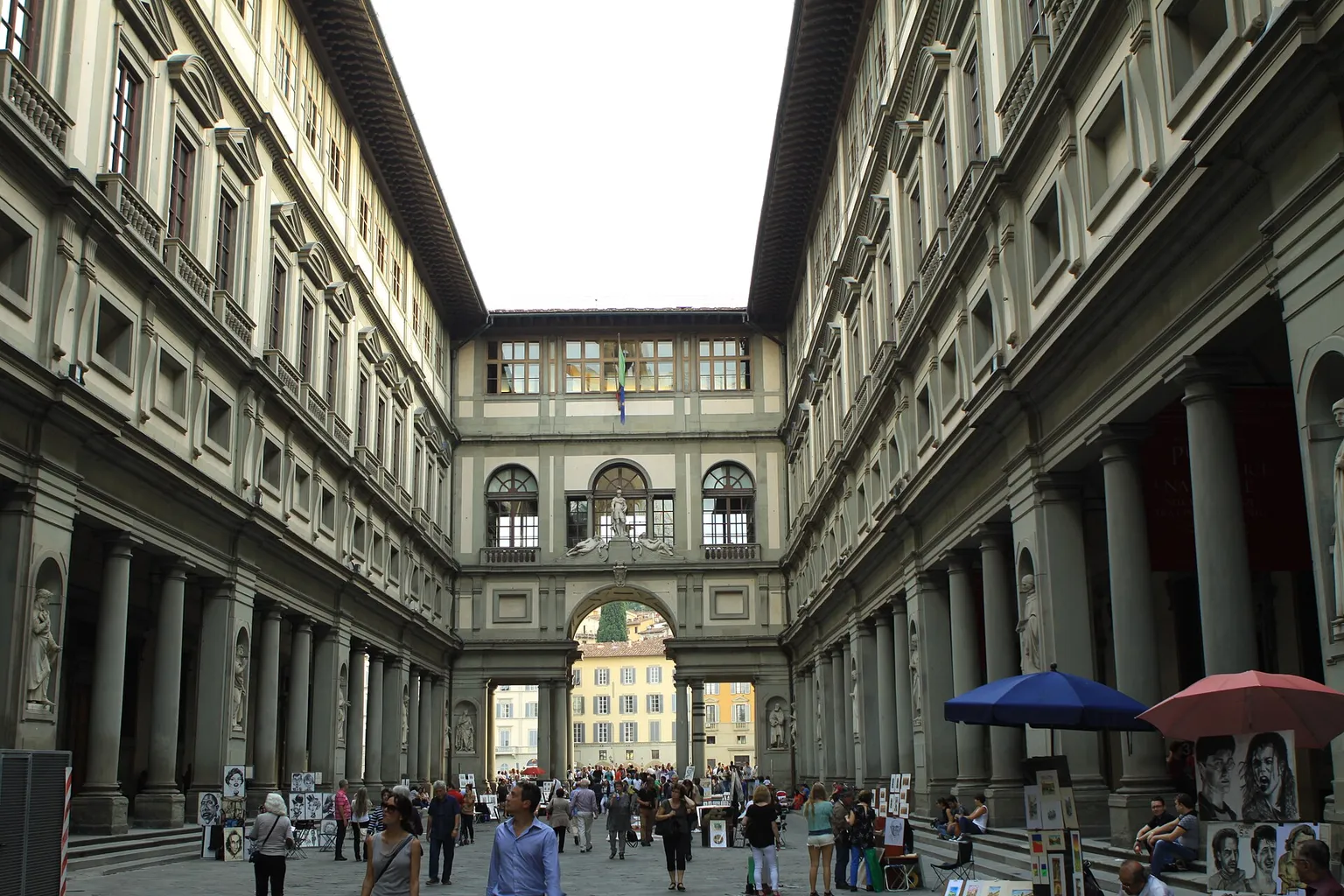
A timed reservation reduces uncertainty at the ticket checkpoint, but it does not remove the metal-detector screening or the need to follow the assigned entry procedure.
 Florence
Tickets and prices
Uffizi Gallery
Entry ticket — standard admission
from€38
Check availabilityEntry ticket — timed entry & app audio guide
from€34
Check availabilitySkip-the-line ticket — multilingual audio guide
from€20−30%
Check availabilitySkip-the-line ticket — audio guide or tour options
from€19−20%
Check availabilitySkip-the-line tour — small group
from€56−23%
Check availabilityThe access system has several independent constraints: booking channel, visitor category, reservation time, identity verification, entrance door, and group size. A failure in any one of them can add latency before admission or prevent entry altogether. Since October 13, 2025, Uffizi tickets are nominative. The name on each ticket must match the physical photo ID or passport presented at the museum.
The correct objective is not simply to book tickets for the Uffizi Gallery. It is to create a valid access record that survives verification at the entrance.
Start with the official booking path
The Uffizi booking process is straightforward when handled through the official museum ticketing system or its designated call center. Advance reservations use timed-entry slots and carry a booking fee. The fee is the cost of reducing arrival uncertainty. It does not buy immunity from security queues.
Third-party platforms may also offer Uffizi admission tickets and guided options. These can be operationally useful when official availability is limited or when the visitor wants a tour rather than a standalone ticket. The trade-off is additional interface complexity. The product may include a guide, an escort to the entrance, a bundled service, or a different collection point. Those details affect the route through the system.
Before completing a booking, identify the actual access product:
- A standard museum admission ticket provides entry without a guided interpretation layer.
- A timed-entry ticket assigns a specific arrival window.
- A guided tour adds a meeting point and a group coordination dependency.
- A combined pass links the Uffizi with other sites and imposes a sequence constraint.
- A ticket connected to the Vasari Corridor has separate access logic and should not be treated as ordinary gallery admission.
The wording “skip-the-line” is operationally limited. It normally refers to bypassing the general ticket-purchase queue or entering through a reserved-access process. It does not bypass security screening. Every visitor remains subject to the metal detector.
A timed slot controls admission capacity. It does not control security latency.
The main source of error is not lack of information. It is selecting a product whose operational model does not match the visit. A visitor seeking independent access should not assume that a guided-tour listing uses the same entrance procedure as an individual reservation. A visitor with a combined pass should not assume that every site can be visited in any order.
Select the ticket category before selecting the time
The Uffizi has several admission categories. They are not interchangeable. The booking system needs a visitor classification before it can produce a valid reservation.
| Access category | Operational condition | Main constraint |
|---|---|---|
| Standard adult admission | Individual visitor using the regular entry route | Timed reservation recommended during high-demand periods |
| Early morning admission | Entry window between 8:15 AM and 8:55 AM | Arrival must align closely with the early slot |
| Afternoon admission | Entry after 4:00 PM | Limited usefulness for visitors planning a long museum visit |
| EU reduced admission | EU citizens aged 18 to 25 | Eligibility must be supported by valid identification |
| Visitor under 18 | Free admission category | A free ticket or reservation is still required |
| Passepartout combined pass | Uffizi, Pitti Palace, and Boboli Gardens over five days | The Uffizi must be visited first at the reserved time |
| Uffizi plus Vasari Corridor | Combined access to the gallery and corridor | Separate product logic and a longer route through the site |
The early morning option is a scheduling tool, not merely a discounted category. It compresses the arrival window into the first part of the operating day. This can reduce exposure to later demand, but only if the visitor reaches the correct entrance with enough time for identity checks and security.
The afternoon option has the opposite profile. It can work for a short visit or a second museum block, but it creates a hard upper bound on gallery time. The Uffizi is not a small single-room collection. A late entry requires explicit scope control. Without it, visitors arrive with a full-day itinerary and receive a partial visit.
The EU reduced category is tied to citizenship and age. It is not a general youth discount. The visitor should carry the document required to establish both identity and eligibility.
Visitors under 18 enter without the standard admission charge, but they still require the appropriate free ticket or reservation. Free admission does not mean no booking record. This distinction matters at the gate because the staff must map every person in the party to an authorized entry.
The five-day Passepartout pass is a different planning object. It connects three locations: the Uffizi Gallery, Pitti Palace, and Boboli Gardens. The Uffizi must be the first site visited, and the initial visit is tied to the reserved time slot. The pass is efficient only when the itinerary can support that sequence. Otherwise, the bundle adds constraints without reducing planning work.
Treat identity verification as a hard system requirement
The nominative-ticket rule changed the access model. Each ticket now represents a specific visitor, not a transferable admission unit. The full name on the reservation must match the name on the physical photo ID or passport shown at entry.
This creates four common failure points:
1. Name mismatch. A shortened first name, spelling variation, or transcription error can create a verification exception.
2. Wrong visitor assigned to the ticket. Tickets should not be casually redistributed inside a group.
3. Missing physical identification. A digital booking confirmation does not replace the required identity document.
4. Unclear category eligibility. Reduced or free admission still depends on the visitor meeting the conditions of that category.
The booking workflow should therefore begin with the final visitor list, not with the preferred time slot. Enter names exactly as they appear on the documents that will be presented. Keep the booking confirmation accessible, but treat it as one component of the access record. The document check is performed against the person at the entrance.
The rule is especially relevant to family and multi-person bookings. Children may enter free, but their presence still needs to be represented correctly in the reservation system. A parent’s ticket does not automatically cover an unlisted child.
There is also a planning implication for third-party bookings. A platform may collect traveler information during checkout, but the visitor remains responsible for reviewing the names and categories shown on the final voucher. The booking interface is not the same as the museum’s verification decision.
Map the entrance before arrival
The Uffizi uses different access points for different visitor flows. Door 1 serves individual ticket holders. Door 2 is designated for guided group entries.
This distinction is basic but consequential. A reservation confirmation is not a complete route description unless the visitor also understands which entrance corresponds to the booking type. A guided group that waits at the individual entrance introduces coordination delay. An individual visitor who moves toward the group entrance creates an avoidable handoff.
The arrival sequence is typically composed of several stages:
1. Locate the correct door based on the booking type.
2. Present the ticket or reservation record.
3. Complete the identity check where required.
4. Pass through metal-detector security.
5. Enter the galleries after staff validation.
The security stage remains active for every visitor, including those holding timed reservations. Bags and personal items can extend processing time. The exact waiting time varies by demand and cannot be fixed in advance. This is why an arrival plan based on the nominal slot alone is weak. It ignores the queue upstream of the gallery.
A timed-entry reservation should be treated as a service window, not as permission to arrive at the last possible minute. The further the visitor travels to reach Florence, the more buffer is required. A missed slot can create a recovery problem because later availability may be constrained.
The museum’s operating day ends at 6:50 PM, but that does not mean a late arrival can be converted into a full visit. The admission window and the usable gallery time are separate variables. The latter depends on ticket type, entry time, security latency, and the scope of the planned visit.
Group access has capacity and equipment thresholds
Group planning introduces constraints that do not apply to a small individual party.
The maximum group size is 16 people. Groups of 11 or more incur an additional group charge. Groups exceeding six people must use a whisper audio system. These are not optional refinements. They are part of the operating model for group access.
A group should be configured before booking. Splitting a large party into informal subgroups does not necessarily remove the group rules. The museum’s procedure is based on how the visitors enter and operate as a party, not merely on how many reservations were purchased in separate transactions.
The group system has three practical effects:
- Capacity: A party above the maximum cannot be processed as one group.
- Cost: Large groups have an additional charge beyond the underlying admissions.
- Communication: Larger parties require whisper audio equipment once they pass the stated threshold.
The audio requirement exists to control noise in the galleries and preserve the operating conditions of the museum. It also affects the tour format. A guide addressing a group without the required system may create a compliance issue at the entrance or inside the collection.
A party of 16 should not be managed like 16 independent visitors. The group has a single coordination surface: one meeting point, one lead person, one document-review process, and one route to the correct door. The more people involved, the higher the probability of name errors, late arrivals, and fragmented communication.
Choose timing based on throughput, not preference
The Uffizi contains high-demand works associated with the Italian Renaissance, including Sandro Botticelli’s Birth of Venus and Primavera, as well as works connected to Leonardo da Vinci and the Medici family. These galleries concentrate visitor demand. The museum experience is therefore not a uniform flow from entrance to exit.
A useful timing decision separates three variables:
- Admission latency: time spent reaching the gate and passing checks.
- Gallery throughput: the rate at which the party can move through rooms without blocking or backtracking.
- Attention budget: the number of works and sections the party can process before the visit becomes inefficient.
Early entry reduces the number of upstream visitors only when the booking and arrival are aligned. It does not guarantee empty galleries. Afternoon entry can be efficient for a targeted route, but it is a poor fit for an attempt to cover the entire collection.
The strongest plan assigns priorities before arrival. For example:
1. Identify the essential works and rooms.
2. Place the highest-demand areas early in the internal route.
3. Reserve time for less congested sections afterward.
4. Avoid treating every gallery as a mandatory stop.
5. Keep the exit time compatible with the museum’s closing schedule.
This is a throughput problem. A visitor who spends excessive time in the first high-demand room may create congestion later in the route. A visitor who attempts to cover every floor may increase cognitive load without improving retention.
Florence also has monthly free-admission Sundays under the “Domenica al museo” program. These dates alter the access environment. Free admission does not imply guaranteed entry, and advance priority reservations are not available in the same way as ordinary timed bookings. Visitors choosing this route should expect a different queue and capacity profile.
The booking sequence that produces the fewest errors
A reliable Uffizi reservation is built in the following order:
1. Fix the date. Exclude Mondays, January 1, and December 25. Confirm that the selected day falls within the Tuesday–Sunday operating schedule.
2. Define the party. List every visitor, including children and visitors using free or reduced categories.
3. Select the access product. Separate independent admission, guided entry, combined passes, and Vasari Corridor access.
4. Choose the time window. Match the slot to the actual Florence itinerary, not to an abstract preference for the earliest or latest entry.
5. Enter names exactly. Use the spelling shown on the identification documents.
6. Review category conditions. Confirm age, citizenship, and any reduced-admission qualification.
7. Save the complete record. Keep the ticket, confirmation, meeting instructions, and ID documents available.
8. Map the entrance. Use Door 1 for individual ticket holders and Door 2 for guided group entries.
9. Add arrival buffer. Account for transport, locating the entrance, identity verification, and security screening.
10. Recheck the route before departure. A booking confirmation is not a substitute for knowing the access door.
The booking fee for an advance reservation is a separate cost from admission. It should be evaluated against the value of schedule control. During high-demand periods, the main benefit is not speed through security. It is reduced uncertainty about whether the visitor will be admitted at all.
Actionable design heuristics for the visit
- Model the Uffizi as a constrained access system, not as a walk-in attraction.
- Treat the timed-entry slot as a control window, not a guarantee of immediate gallery access.
- Use the official booking channel when the requirement is a direct museum admission record.
- Verify every name against the physical passport or photo ID before finalizing the reservation.
- Keep free-admission visitors inside the booking logic. Free does not mean unregistered.
- Separate individual entry from guided-group entry. The doors are different.
- Keep groups at or below the permitted capacity. Do not rely on informal splitting.
- Add whisper audio equipment to the plan for groups exceeding six people.
- Use early slots for maximum schedule control and afternoon slots for targeted visits.
- Treat combined passes as sequence-dependent products. Visit the Uffizi first when required.
- Do not describe security screening as bypassed by a skip-the-line ticket.
- Do not assume a ticket can be transferred after purchase.
- Plan around the actual operating window, from 8:15 AM to 6:50 PM.
- Build the route around priority works such as Botticelli’s Birth of Venus and Primavera, rather than attempting uniform coverage.
- Recheck temporary conditions before travel. Exhibition surcharges and operational details can change.
The Uffizi access process is manageable when its dependencies are handled in the correct order. The failure mode is usually procedural: wrong category, wrong name, wrong door, insufficient group planning, or a schedule that ignores security latency. Book the correct product, preserve the identity match, arrive at the assigned entrance, and treat the visit as a timed system with finite throughput. That is the reliable route into the gallery.
Practical info
Currency: EUR
Driving: on the right
Emergency number: 112
FAQ
Do I need to book a ticket for a child under 18?
Can I use a skip-the-line ticket to avoid security?
What happens if the name on my ticket does not match my ID?
Which entrance should I use for the Uffizi Gallery?
How does the Passepartout combined pass work?
Are there specific rules for visiting in a group?
Photo: Arek N. / CC BY-SA 3.0 — Wikimedia Commons