Industrial roller chain elongation: options for measuring wear and service limits
A chain drive can sound perfectly ordinary at the start of a shift and still be quietly consuming its sprockets.
The operator notices the practical symptoms first: a tensioner that has reached the end of its travel, a rhythm in the guard that was not there last week, a chain that needs adjustment more often, or a conveyor that no longer feels as steady under load. On the ground, those are not small annoyances. They are the early friction points that turn a straightforward maintenance task into an unplanned stop.
The phrase “chain stretch” does not help much here. Industrial roller chains do not normally become longer because their side plates are stretching like a rubber band. What we see as elongation is primarily accumulated wear at the pin-and-bushing bearing surfaces. Each worn joint adds a very small amount of clearance; multiplied across dozens or hundreds of pitches, that clearance changes how the chain seats on the sprocket.
That is why industrial roller chain wear elongation measurement methods need to begin with the drive arrangement, not simply a percentage written on a maintenance sheet. If you measure the chain correctly but apply the wrong service limit, you can still make the wrong call.
Wear lives inside the joints, not in the side plates
Let’s start with the part that is often misunderstood during a hurried inspection. A roller chain has plates, pins, bushings, rollers, and lubricant working together at every articulation point. The critical wearing interface for elongation is the pin-and-bushing relationship. As that interface wears, the pitch distance from one pin center to the next increases.
The side plates are under tensile load, certainly, and an overloaded or damaged chain can deform in serious ways. But normal in-service “stretch” is not elastic plate growth. It is a cumulative wear condition. Calling it stretch can encourage the wrong response: pull the chain tighter, take up more slack, and keep running. That may hide the symptom temporarily while making the sprocket engagement worse.
If the chain pitch has effectively increased, the chain no longer meshes cleanly with the tooth spacing that was manufactured for it. The load migrates toward fewer teeth. The chain climbs and seats less gracefully. Tooth flanks begin to wear into a profile shaped by the worn chain rather than by the original geometry.
A tensioner can recover slack. It cannot restore the pitch relationship between a worn chain and an unworn sprocket.
This is where the real-world context matters. On a lightly loaded, adjustable-center drive, there may be room to respond before damage becomes expensive. On a fixed-center drive, a high-speed drive, or a system with parallel chains sharing load, the same percentage of elongation can create a much more immediate operating problem.
Before we take a measurement, we should also separate elongation from other conditions that can make a drive look tired:
- Poor lubrication accelerates pin-and-bushing wear, often alongside stiff joints, heat, discoloration, or a dry metallic sound during articulation.
- Misalignment can create uneven plate wear, side loading, roller distress, and one-sided sprocket tooth wear even when measured elongation is not yet severe.
- Contamination turns lubricant into an abrasive paste. In washdown, dusty, or particulate-heavy environments, the chain may deteriorate far faster than its calendar age suggests.
- Overload and shock loading can damage plates, pins, or attachments. This needs a separate inspection rather than being folded into a simple elongation percentage.
- Worn sprockets can make a replacement chain perform poorly from day one. The chain and sprocket are a mating system, not independent catalogue items.
When we frame the problem this way, the measurement becomes useful: it tells us how much joint wear has accumulated and how far the drive has moved away from its designed pitch geometry.
The tensioned multi-link measurement: the dependable field method
For most maintenance teams, the clearest power transmission chain elongation check is a dimensional measurement over several links while the chain is lightly tensioned. The word “tensioned” deserves emphasis. A slack chain has clearance distributed randomly from joint to joint, so its apparent length can change depending on how it is lying and who is holding the tape.
We want the joints to settle in one consistent direction, with enough light load to take up normal clearance without imposing an undefined heavy pull. There is no universal force value that applies to every chain size and drive. What matters is repeatability and following the chain manufacturer’s procedure where one is specified.
A practical inspection path looks like this:
1. Isolate the equipment and expose a clean section of chain. Lockout procedures come first. Then remove enough grease, debris, and product buildup to identify rollers, pins, and pitch points accurately. Measuring over a dirty chain gives you the confidence of a number without the reliability of one.
2. Choose a representative span, then choose more than one. Wear is not always uniform. A chain can spend most of its life loaded in one region, pass through a contaminated zone, or develop localized damage near an attachment. Start with a straight, accessible span, but inspect several key areas before declaring the chain sound.
3. Apply light, steady tension. If the drive design allows it, position the chain so normal slack is removed. Do not force the chain as though you are proof-loading it. We are seating the joints for measurement, not adding a new wear event.
4. Measure across approximately six to ten links where practical. A longer sample reduces the influence of tiny reading errors. If a tape measure is the only available tool, extend the measured length as far as access allows. Vernier calipers provide finer resolution for shorter spans, but a longer careful measurement can be more meaningful than a highly precise reading taken across too few pitches.
5. Measure consistently from roller reference to roller reference. One established approach is to measure the inside roller distance and outside roller distance at both ends of the selected span, then average those readings to establish the judgment length. This helps account for roller geometry rather than letting one arbitrary edge define the result.
6. Compare the measured length to the nominal pitch length. The standard length is simply chain pitch multiplied by the number of links or pitches measured. The calculation then converts the difference into a percentage.
The formula is straightforward:
Wear elongation (%) = ((measured length − standard length) / standard length) × 100
If a chain has a nominal pitch of 25.4 mm and we measure ten pitches, its standard length is 254 mm. If the tensioned measurement comes out at 257.81 mm, the calculation is:
((257.81 − 254) / 254) × 100 = 1.5%
That figure tells us the chain has accumulated 1.5% pitch elongation across the tested span. It does not, by itself, tell us to replace the chain. The drive arrangement has the final word.
Why longer spans produce better decisions
A single-pitch measurement can be misleading because the wear involved is very small and the physical interfaces are not easy to reference perfectly in a real plant environment. Roller position, dirt, access constraints, tool angle, and the person holding the chain all influence the reading.
Think of it like judging the straightness of a long production rail with a ruler only a few centimeters long: the tool may be accurate, but the sample is too small to reveal the condition you need to manage. A six-to-ten-link sample gives the accumulated wear room to become visible.
We should also record the result by location. “Chain measured at 1.4%” is less useful than “1.4% at the accessible return span, 1.7% near the loaded drive-side section.” That small habit helps the next technician understand whether the chain is wearing evenly or whether a lubrication, alignment, or contamination issue is concentrating damage in one part of the loop.
Service limits are a drive decision, not a universal number
The familiar 3% figure is a general service limit often cited for roller chains, but it is not permission to run every chain drive to 3%. The more constrained the drive geometry and the more demanding the running conditions, the earlier elongation becomes operationally unacceptable.
This is one of those maintenance decisions where a single number can create operator fatigue. If the rule is always “wait until 3%,” the team is left adjusting, listening, guarding against jump risk, and explaining recurring tracking or timing issues that the rule did not account for. A better approach is to classify the drive first.
| Drive condition | Typical wear-elaboration guidance | Why the limit becomes tighter |
|---|---|---|
| Adjustable-center drive, up to 5 m/s | Up to 3% may be acceptable | Center-distance adjustment can accommodate some wear, provided sprocket condition remains sound |
| Adjustable-center drive above 5 m/s | About 1.5%–2% | Higher speed magnifies vibration, engagement error, and smoothness problems |
| Fixed-center drive, up to 2 m/s | About 1.5% | There is little or no adjustment available to recover geometry |
| Fixed-center drive above 2 m/s | About 0.8% | Faster operation leaves much less tolerance for pitch mismatch |
| Parallel chains or smooth-running applications | About 1.5% | Load sharing and synchronized motion depend on closely matched chain behavior |
| Large sprocket with more than 67 teeth | Use the relationship 200/N% | Tooth count changes the allowable pitch mismatch; N is the large sprocket tooth count |
The table is a route map, not a substitute for the equipment manufacturer’s maintenance requirement or the chain supplier’s application guidance. Different manufacturers publish slightly different thresholds because they are accounting for different drive conditions, sprocket sizes, speeds, and performance expectations.
For a large sprocket, the relationship 200/N percent is especially helpful. If the larger sprocket has 100 teeth, the allowable wear derived from that relationship is 2%. If it has 200 teeth, the figure falls to 1%. The point is not to turn the maintenance floor into a mathematics class. The point is to recognize that large tooth counts can make the standard 3% habit inappropriate.
If the drive has fixed centers, then even a chain that appears visually calm may be approaching a limit sooner than the team expects. If it is a parallel-chain conveyor, then one chain becoming longer than its mate can disturb load sharing and introduce a persistent uneven pull. If the process requires smooth motion, as with indexed equipment or product-sensitive conveyance, the service limit should reflect that operational requirement rather than the most permissive general number.
The useful replacement limit is the one that protects sprocket engagement and production stability in your drive—not the largest percentage a chain might survive.
This is also why early replacement around 1.5% to 2% is often a practical decision even where a general 3% number is familiar. It can protect sprockets from the much more expensive stage of wear, especially when the chain has been running under demanding conditions.
Wear gauges make routine inspection faster—if they match the chain
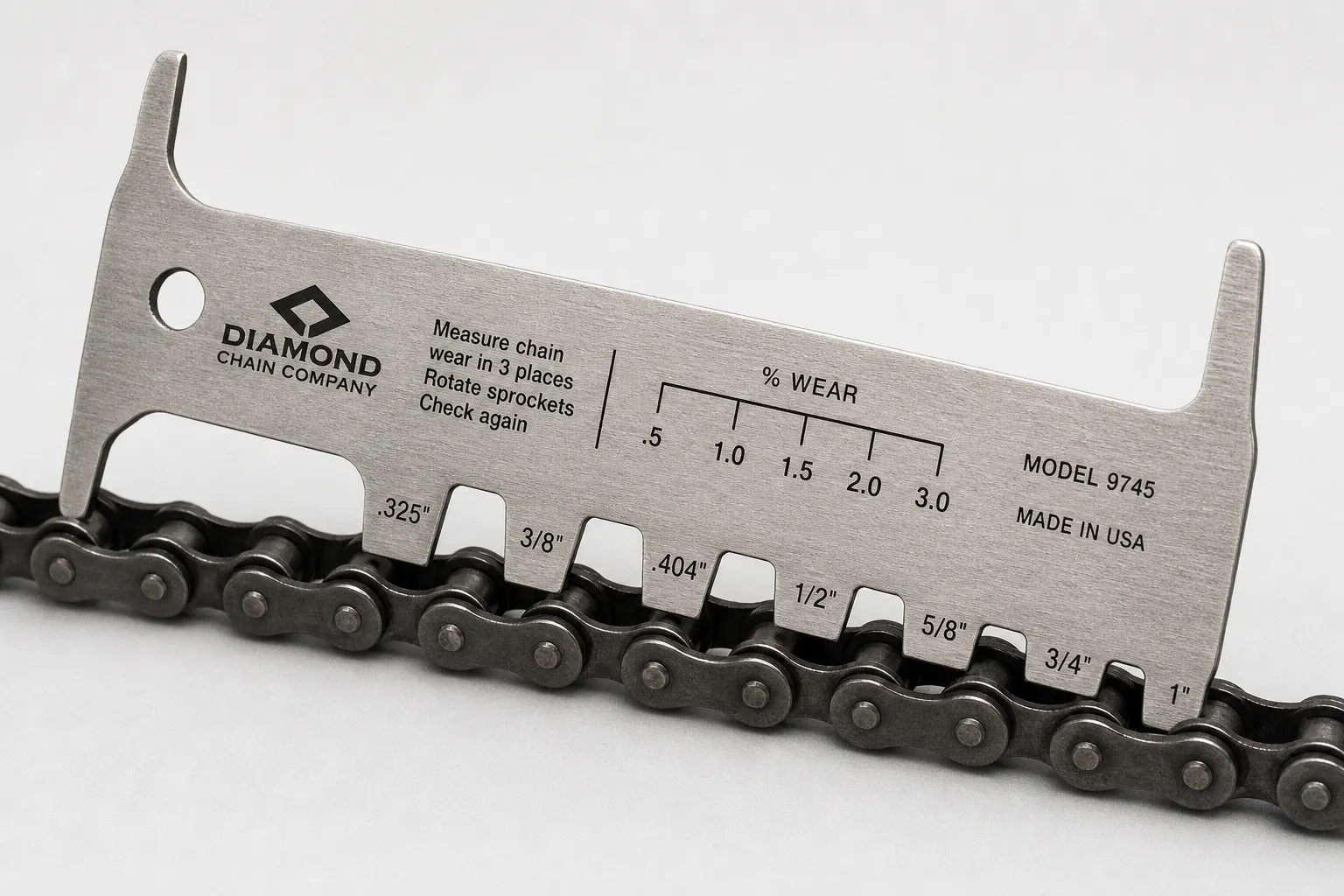
A purpose-made industrial chain wear gauge application can be excellent for a recurring route. It removes arithmetic from the inspection round and gives technicians a consistent go/no-go decision point. But the gauge needs to match the chain pitch, and it must be used on a properly tensioned section of chain.
The usual logic is simple: identify the chain pitch, select the corresponding gauge step, hold the chain under tension, and place the gauge over the specified points. If the wear step passes through the checkpoint as designed, the chain has reached or exceeded the gauge’s threshold.
This is particularly useful where several people inspect the same equipment across shifts. The tactile feedback is immediate. Instead of one person estimating an extra millimeter on a tape and another reading from a different roller edge, the team uses the same physical reference and the same decision language.
Still, a gauge should not make us stop looking.
If the gauge indicates replacement, then inspect the sprockets before issuing a chain alone. If the chain is below the limit but the drive is noisy, surging, or repeatedly losing adjustment, inspect beyond the gauge result. The instrument tells us about pitch wear. It does not diagnose every mechanical condition surrounding it.
What to inspect alongside the chain
A solid drive chain maintenance inspection path includes the mating components and the causes of wear, because replacement without correction is simply restarting the same failure curve.
Look closely at:
- Sprocket tooth flanks and pockets. Hooking, sharp profiles, uneven wear from side to side, or teeth shaped to match an elongated chain are warning signs. A new chain on worn sprockets can be pulled into poor engagement almost immediately.
- Roller seating. Rollers should enter and seat in the tooth pockets smoothly. Signs of climbing, impact marks, or abnormal polish point to a pitch or alignment problem.
- Chain tensioning range. If the adjustment is near its limit, document it. Repeated take-up is not neutral maintenance activity; it is often the visible consequence of progressing joint wear.
- Alignment. Check sprockets, shafts, bearings, and mounting rigidity. A chain running sideways across teeth is not going to give an honest service life, no matter how carefully it is lubricated.
- Lubricant delivery. Confirm that lubricant reaches the pin-and-bushing interfaces rather than merely coating the outside plates. Excess lubricant on the exterior can look reassuring while the working bearing surfaces remain underfed.
- Stiff or seized joints. Elongation is not the only retirement mechanism. A chain can be within a percentage limit and still need attention because joints are binding, corroded, or damaged.
- Attachments and connecting links. On conveying systems, attachments may see loading that the base chain measurement does not reveal. Inspect fasteners, attachment plates, and connecting links in the same route.
If-then thinking works well here. If elongation is rising evenly across the chain, then normal joint wear and lubrication quality may be the primary story. If one area is distinctly longer, then look for a localized process condition: contamination, a damaged guide, a splash zone, a misaligned sprocket, or an attachment loading event. If a replacement chain shows rapid early elongation, then the root cause was probably not the old chain’s age.
Building an inspection routine people can actually sustain
There is no universal inspection interval for industrial roller chain drives, and pretending otherwise creates false confidence. A chain in a clean, lightly loaded, well-lubricated enclosure does not need the same attention as one working through abrasive dust, temperature cycling, washdown, shock loads, or continuous operation.
The better question is: what condition change would cause this drive to become disruptive before the next planned maintenance window?
We can build around that question by keeping the routine proportionate to the duty:
- For critical drives, establish baseline measurements after installation and trend elongation at planned intervals. The trend is often more valuable than one isolated reading.
- For dirty or wet environments, combine dimensional checks with a review of lubrication delivery and contamination control. If abrasive material is reaching the joints, measurement alone is only documenting the damage.
- For fixed-center and high-speed drives, use the tighter applicable discard criteria and inspect sprocket engagement early. These systems have less forgiveness in their geometry.
- For multi-strand or parallel-chain systems, measure each chain and compare them. A small difference can matter where synchronized load sharing is part of the design.
- For drives with limited access, plan the measurement point into the machine layout or guarding strategy. A measurement nobody can take safely and consistently will become a measurement nobody takes.
Standards for precision roller chains and sprockets establish dimensions, tolerances, and selection guidance, but they do not relieve us of this practical judgment. The right maintenance decision sits at the intersection of the chain’s measured condition, the drive layout, the operating speed, sprocket tooth count, and the consequence of degraded motion.
That may sound like more work than simply writing “replace at 3%” on a lubrication chart. In practice, it is less work than explaining why a preventable sprocket-and-chain replacement became an emergency job.
Measure the chain, then protect the person running the line
A good elongation inspection is not about chasing perfect numbers for their own sake. It is about giving the maintenance team a reliable way to see wear before the drive begins to punish everyone around it: the operator hearing a new impact noise through the guard, the technician making repeated tension adjustments, the planner trying to fit an emergency repair into a full schedule.
Measure a clean, lightly tensioned span across enough pitches to make the reading meaningful. Repeat the check in several areas. Use a compatible wear gauge where it makes routine inspection more consistent. Then apply a service limit that belongs to the actual drive—especially when fixed centers, higher speeds, parallel chains, smooth motion, or large sprockets reduce the margin.
When we do that, chain maintenance becomes calmer and more legible. The operator gets a steadier machine, the technician gets tactile feedback and evidence instead of guesswork, and the plant avoids wearing a chain so far that it takes the sprockets down with it.