Teflow Mortar Pump Upgrade: Solving LFP Slurry Crystallization with API 682 53A
Teflow has just rolled out a dedicated mortar pump fitted with an API 682 53A mechanical seal flush plan, and according to the company the design targets one of the messier pain points we keep…
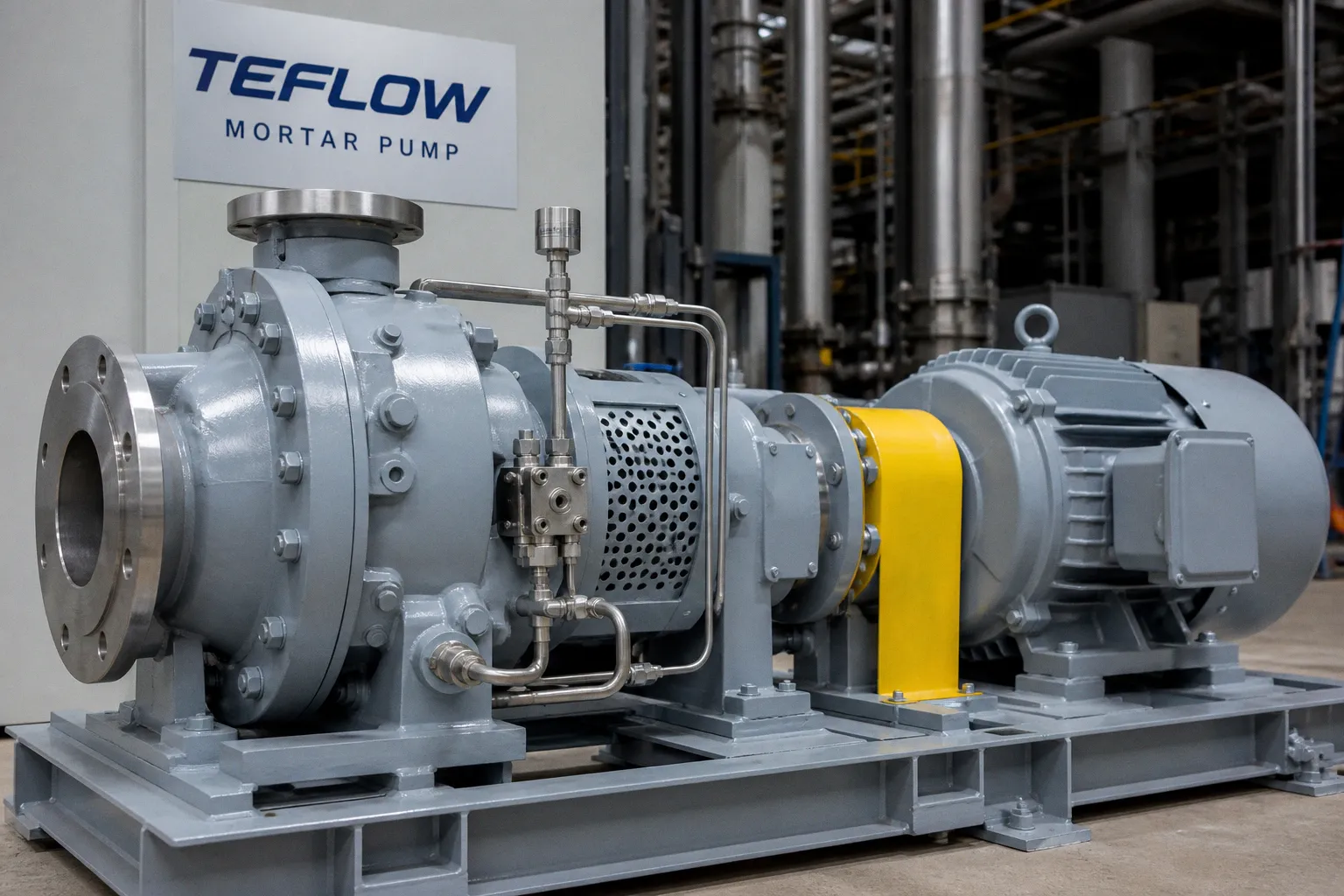
Teflow has just rolled out a dedicated mortar pump fitted with an API 682 53A mechanical seal flush plan, and according to the company the design targets one of the messier pain points we keep hearing about on LFP battery production lines — particle erosion and crystallization jamming during lithium-iron-phosphate mortar transfer. It's the kind of release worth understanding from the operator's side of the line, because the seal flush arrangement is what quietly decides whether your shift ends on time or not.
The shift where it usually falls apart
Picture the third hour of an overnight run. You're watching the slurry gauge on a transfer line feeding the reactor, and the pump that looked fine at startup is starting to chatter. That's the moment you start wondering whether the seal chamber has packed with ultrafine LFP powder again. If you've stood next to one of those lines, you know the pattern: heavy abrasion from high-solid mortars, deposition inside the seal cavity, and crystals forming where the flush water can't quite reach. Conventional transfer pumps take that beating on the seal faces, and before long you're scheduling an unplanned stop, draining the line, and eating into the production budget for the week.
Teflow's new unit is built around the API 682 53A flush plan — a configuration the company positions as engineered for seal protection, stable operation, and long-term durability in exactly that kind of service, where solid content is high, abrasion is heavy, and crystallization is a constant risk.
Why the flush plan matters on the ground
We tend to think of flush plans the way a mechanic thinks of oiling intervals: it's the quiet decision that decides whether you finish the run. With a 53A arrangement, the seal faces get a controlled flow of barrier or buffer fluid that keeps particles from settling on the working surfaces and carries heat away. On an LFP line, that translates into fewer of those start-stop failures you get when a seal finally gives up, and less of the workshop contamination that comes with a slow leak nobody caught in time. The pump is custom-manufactured in batches for major LFP producers, and Teflow frames it as a safeguard against the unplanned shutdowns that quietly inflate O&M costs and shave capacity.
What we'd watch next
If you're specifying equipment for an LFP line, or auditing one that's already running, the practical questions are straightforward. Ask how the 53A flush is plumbed into your utilities, what the barrier or buffer fluid consumption looks like over a full production campaign, and whether the seal chamber geometry on this model is open enough to flush clean during a short maintenance window. Then push the vendor — in this case Teflow — for the performance curves, dimensional drawings, and material breakdown you'd expect with any serious transfer pump, so your maintenance crew can troubleshoot without phoning overseas at 2 a.m.