Uniflow Scales Valve Production to Slash Industrial Lead Times
If you've ever stood on a refinery platform waiting on a replacement control valve — the unit you need to bring back online idling on the other side of a 30-week procurement window — then you already…
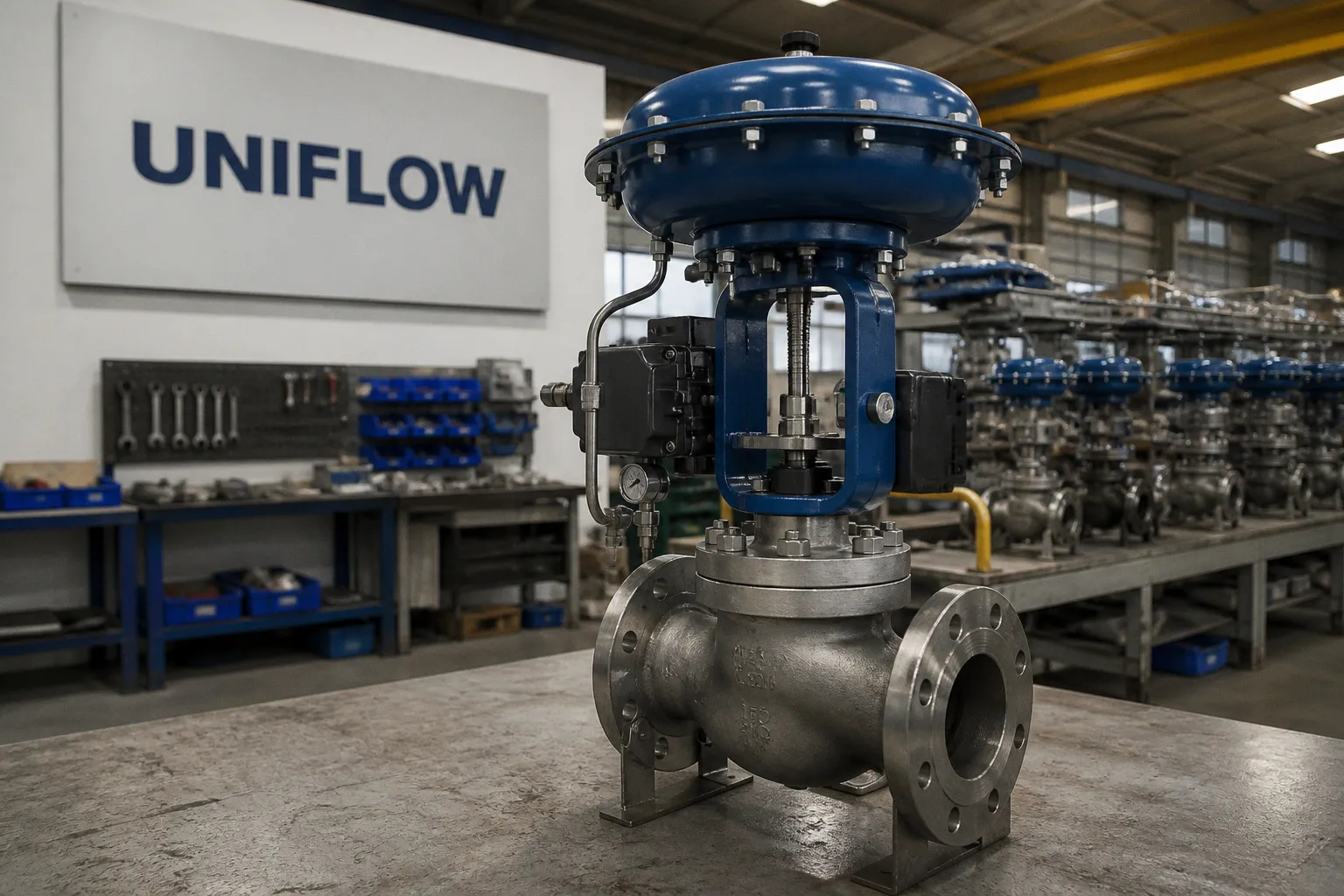
If you've ever stood on a refinery platform waiting on a replacement control valve — the unit you need to bring back online idling on the other side of a 30-week procurement window — then you already understand why Uniflow's announced five-fold capacity expansion matters more than the headline lets on. According to Chemical Industry Digest, the Indian control-valve manufacturer is committing ₹50 crore (roughly US$5 million) to lift annual output from around 8,000 units to 40,000–50,000, anchored by a new Industry 4.0-compliant facility at Ambernath near Mumbai. The stated goal is to chip away at the 35–40% of critical severe-service valves India currently imports. The goal on the ground, where the rest of us live, is shorter lead times between "we need a cryogenic globe valve" and "it's on the bench."
What the Ambernath facility actually changes for operators
Picture the current state: a maintenance planner in a coastal LNG terminal pulls a worn trim kit on a high-pressure control valve at the start of a turnaround. Today the spec goes to procurement, the procurement team learns domestic supply is constrained, and the order either ships from a European or North American supplier in 26 to 40 weeks — or it slips. The Ambernath facility is being designed around that exact friction. Uniflow says the line will integrate CNC machining for precision bodies, Industrial Internet of Things systems, AI-enabled predictive maintenance on the production equipment itself, computer-vision-based inspection, and automated inventory and storage.
For you, the maintenance lead or project engineer, that machinery matters less as a marketing bullet and more as a serviceability promise. If-then: if a domestic line can prototype a custom anti-cavitation trim in weeks rather than months, then your turnaround kit no longer rides on a single overseas supplier. If-then again: if the manufacturer is running vision inspection at every seat, then the as-built documentation you receive with each valve is more likely to actually match the nameplate, and your quality team spends less time arguing about traceability at the receiving dock.
The new line is also being positioned for the difficult service classes — high-pressure, cryogenic, anti-cavitation, corrosion-resistant — where the cost of a field failure is rarely just the cost of the part. Uniflow Managing Director Manoj Mishra framed the investment as building a future-ready manufacturing ecosystem rather than simply adding tonnage, with LNG and nuclear energy as the specialised segments the company intends to enter.
Why this is landing in the same season as the Leistung deal
The Uniflow announcement is not arriving alone. Refindustry reported that Dover Corporation agreed to acquire Leistung Engineering, an India-based maker of cryogenic globe, check and control valves, plus diaphragm valves and filtration systems. Leistung is set to fold into OPW Fluid Transfer Solutions within Dover's Clean Energy & Fueling segment once the deal closes, which is expected in the fourth quarter of 2026. David Malinas, president of OPW, said the acquisition strengthens the company's ability to serve the rapidly growing Indian market while expanding its global cryogenic footprint.
Read the two announcements together and the same pressure shows up twice. LNG and gas-pipeline investment is pulling cryogenic and severe-service flow-control hardware into India faster than the traditional import pipeline can absorb. If you are scoping valve procurement for a new LNG receiving terminal, a gas-grid upgrade, or a nuclear balance-of-plant package over the next 18 months, you now have at least two domestic-or-domestic-adjacent sources competing on lead time for the same hard-to-source seats.
What to do with this on Monday morning
Three small things worth doing this week. First, pull your current critical-valve vendor map and mark every seat that is single-sourced from outside India, with the quoted lead time — those are the exact lines the Ambernath expansion is meant to relieve. Second, ask any domestic supplier you already use for the lower-pressure globe and check valves whether they have plans for cryogenic or anti-cavitation extensions; the competitive ground is shifting under both Uniflow and the soon-to-be-Dover-owned Leistung. Third, if you have a live tender closing in Q1 2027, treat this as permission to add a domestic severe-service bidder to your shortlist rather than waiting for a 40-week import window to dictate the schedule. The quieter promise underneath all of this — fewer late-night calls about a valve stuck on a container ship, fewer turnarounds built around a single foreign supplier's calendar — is the one your operators will actually feel.