How S Jones Conversions and Grundfos Redesigned Mobile Pump Systems for Field Safety
That everyday friction — the kind operators live with when units are designed from the spec sheet outward rather than from the job site inward — is exactly what caught my attention in the partnership…
S Jones Conversions in partnership with Grundfos
When you're standing on a wet verge at 2 a.m. trying to rig a mobile booster pump for an emergency water main repair, the last thing you need is a pipe inlet that forces you to shoulder-lift a heavy run of fittings up to chest height. That everyday friction — the kind operators live with when units are designed from the spec sheet outward rather than from the job site inward — is exactly what caught my attention in the partnership between S Jones Conversions and Grundfos, reported by MEM Magazine.
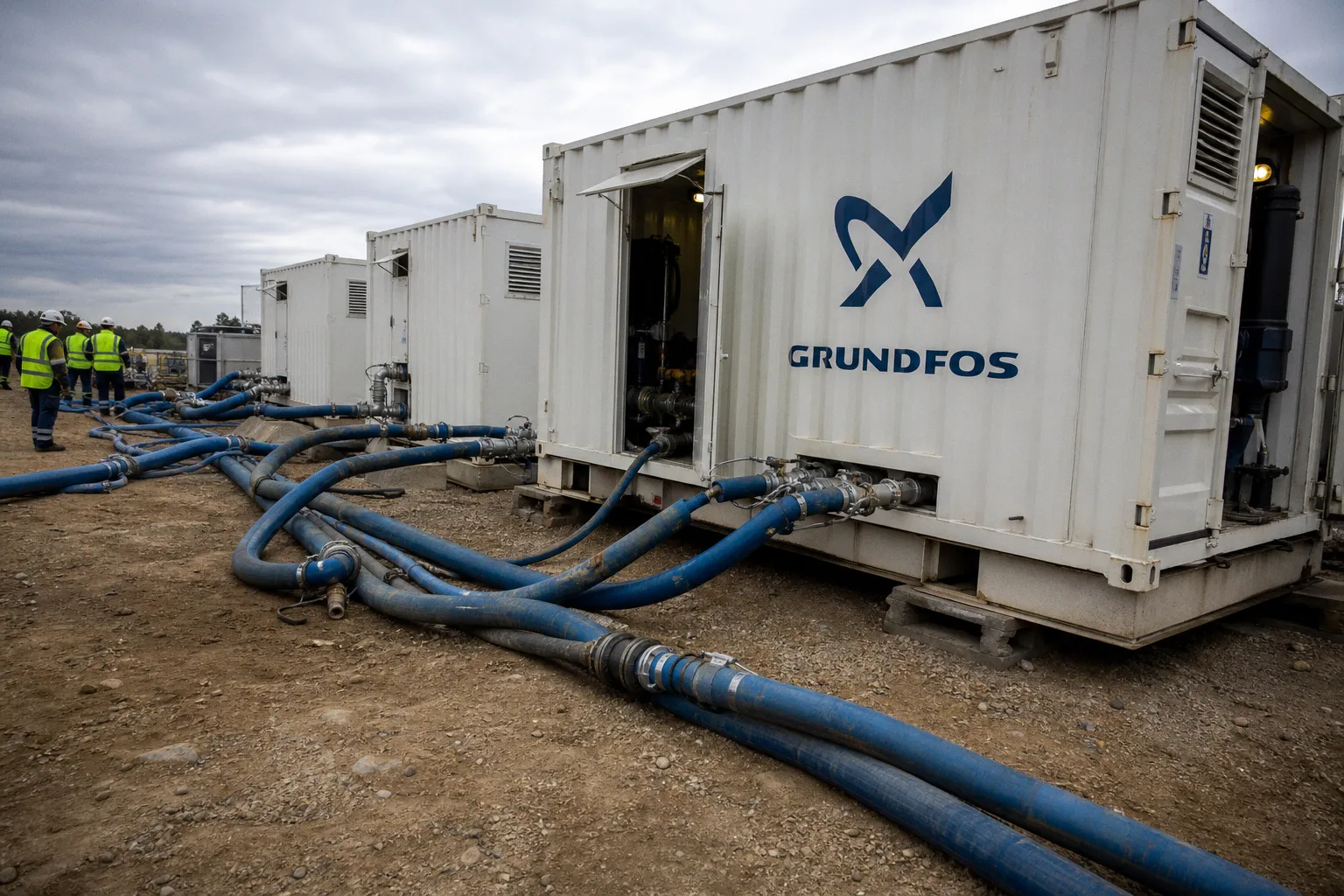
The collaboration produced six containerised mobile pump systems for Severn Trent Water's clean water resilience programme. Grundfos, Severn Trent's framework supplier for vertical multistage pumps, engineered the booster systems; S Jones Conversions handled the shipping container modifications — two separate arrangements of 20ft units configured to be rolled onto trailers, deployed across the network, then redeployed again when the next site needs them.
What the HAZOP study surfaced
Before a single container was cut, the teams ran a detailed Hazard and Operability study during the initial design phase. What emerged was a straightforward but often-overlooked risk: the original pipe inlet and outlet positions on the mobile units required operatives to manually lift piping that, given its size and weight, posed a real manual handling hazard. S Jones reconfigured those connection points, lowering them to a position that reduces the lifting burden. It's a small adjustment on a drawing — but on the ground, when you're connecting and disconnecting fittings across a long shift, that difference in height translates directly into reduced operator fatigue and lower injury risk. If the design hadn't accounted for this, you'd see crews improvising with gantries or asking for extra hands on a job that should only need two.
Mobility as a design constraint
Static containerised plant rooms are a known quantity — you bolt them down, run services to them, and leave them. Making a pump enclosure genuinely mobile introduces a layer of complexity that's easy to underestimate. Every component inside has to survive the jolt of a roll-on roll-off trailer loading cycle without shifting, without stressing pipe joints, without cracking a control panel mounting. The team at S Jones had to configure internal layouts so pumps, pipes, and control equipment stayed secure during transit while still allowing fast access once the unit was on site. Each container was fitted with side-opening access doors — not a hinged end wall, not a narrow personnel door, but a side-opening arrangement that lets operatives get to the equipment without crawling over or around other components. When you think about how often these units need to be accessed under time pressure — a burst main doesn't wait for you to find the right door — that design decision pays for itself the first time.
What this means for the network
Six containers, two configurations: one system with six pumps paired across three containers, and another with three containers each housing its own standalone pump. All modified at S Jones' in-house workshop in the Midlands, all designed so they can be redeployed across Severn Trent's network as conditions demand. For water utilities facing ageing infrastructure and increasing weather volatility, this kind of modular, rapidly deployable capacity isn't a luxury — it's the difference between a planned interruption and a prolonged outage.
From a service design standpoint, the partnership illustrates something we see repeatedly: the best outcomes happen when the pump supplier and the enclosure fabricator work as a single team from the HAZOP stage forward, rather than handing off a spec and hoping the integration works out. The pipe inlet redesign, the access door configuration, the transit-proof internal layout — none of these would have emerged from a siloed process. If you're evaluating containerised pump solutions for your own network, the question to ask your suppliers isn't just what capacity can you deliver? — it's how did you arrive at the design, and what operator feedback shaped it?